

A well-planned suspension upgrade for street cars should make every mile more precise, not merely make the car sit lower. On a favorite back road, that can mean cleaner turn-in, more composure over uneven pavement, and better confidence when the surface changes mid-corner. During the daily commute, it should also mean a controlled ride that does not punish occupants or turn every expansion joint into an event.
For a premium street car, suspension is not a one-part purchase. It is a system that connects tires, chassis geometry, braking, steering response, ride quality, and the way the vehicle communicates with its driver. The right setup respects the original engineering while sharpening the qualities that made the car special in the first place.
Start With the Street Car You Actually Drive
The best suspension choice depends on how the vehicle is used, not on the most aggressive specification available. A Porsche 911 used for weekend drives has different needs than a BMW M car handling Peninsula commutes, or a Mercedes-AMG that must remain composed with passengers, luggage, and Bay Area road imperfections.
Before selecting components, define the goal in practical terms. Is the priority reduced body roll? A lower, more purposeful stance? Improved response under braking? Better support for wider wheels and performance tires? Or is the real issue that tired factory dampers have made the car feel loose and disconnected?
Those answers determine the appropriate spring rate, damper valving, ride height, alignment range, and supporting hardware. A setup built exclusively around maximum stiffness may feel impressive for ten minutes, then become tiring on real roads. Conversely, a modest upgrade with quality dampers and a thoughtful alignment can transform a car without compromising its character.
Springs and Dampers Must Work Together
Springs support the vehicle and establish its ride height. Dampers, commonly called shocks or struts, control how quickly the springs move. Installing lowering springs on worn original dampers is one of the most common ways to create an unsettled street car. The result can be bouncy ride behavior, repeated bottoming, reduced tire contact over rough pavement, and a car that looks better parked than it feels at speed.
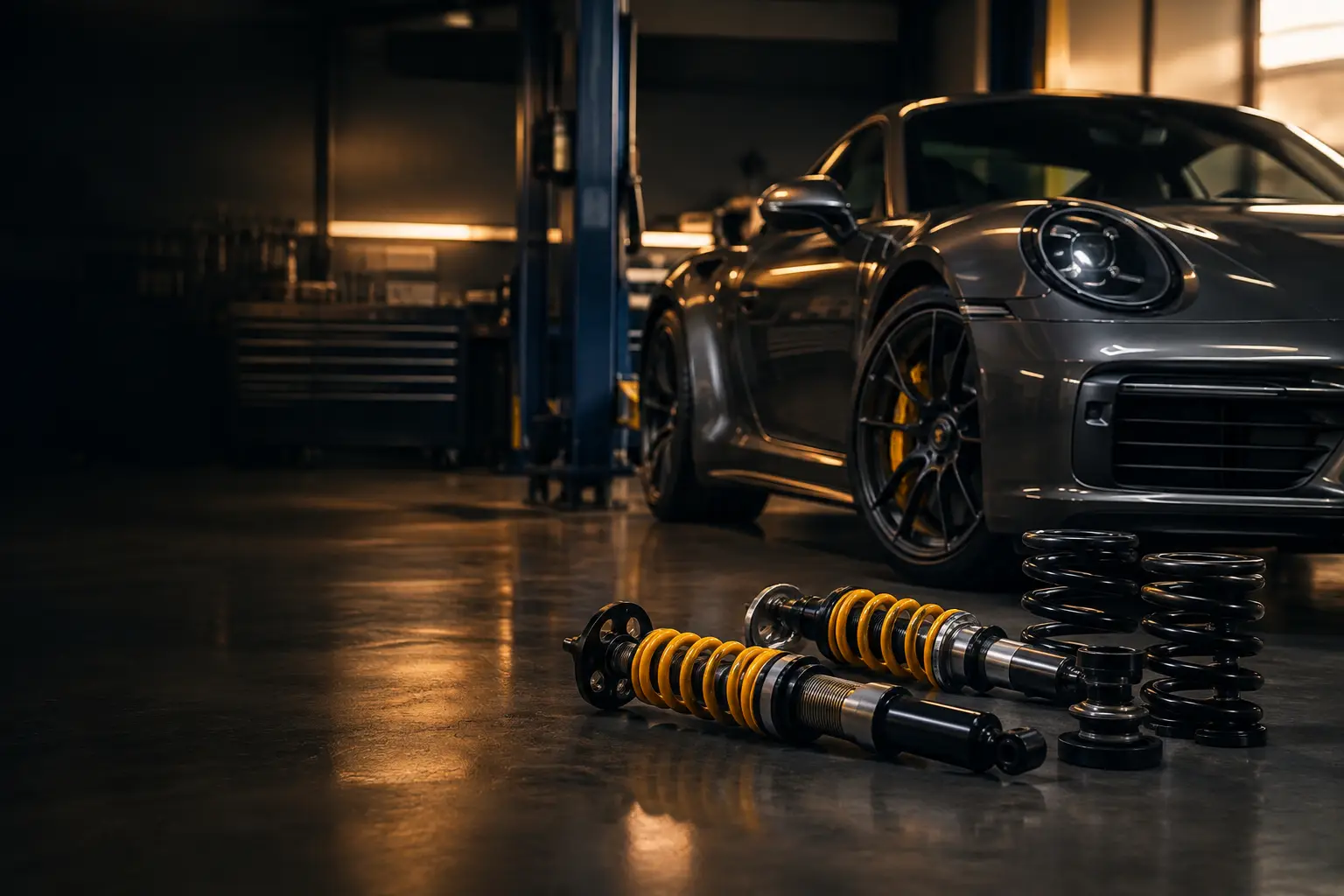
Matched spring-and-damper packages are often the strongest choice for drivers who want a clear improvement without extensive adjustment. The components are engineered to work as a pair, typically offering a more controlled ride, lower center of gravity, and predictable behavior under load.
Coilovers add ride-height adjustment and, depending on the system, adjustable damping and camber provisions. They are valuable when a vehicle needs precise corner balancing, wheel-and-tire fitment, or a tailored driving feel. Yet their range of adjustment is not automatically an advantage. Poorly set coilovers can ride harshly, lose usable suspension travel, and upset chassis balance. Quality hardware, proper installation, and experienced calibration matter far more than the number of adjustment knobs.
For a road-focused build, preserving suspension travel is often more valuable than chasing the lowest possible ride height. A car needs room to absorb a dip, crest, or broken section of pavement while keeping the tires loaded. Once it rides on bump stops or scrapes through normal driveways, performance and practicality both suffer.
Damper Quality Defines the Driving Experience
Premium dampers make a distinction an experienced driver feels immediately. They can be firm without being brittle, allowing the chassis to settle quickly after a bump rather than continuing to oscillate. On a fast road, that control helps maintain tire contact. In normal driving, it creates a more composed, expensive-feeling ride.
Single-adjustable systems generally alter rebound damping, while more advanced designs can separate rebound and compression control. That capability is useful, but it also requires a disciplined approach. Starting from a proven baseline and changing one setting at a time is far better than turning every adjustment toward maximum stiffness.
Electronically controlled factory suspension adds another layer of consideration. Many modern European performance vehicles use adaptive dampers integrated with drive modes and chassis electronics. An upgrade should preserve appropriate functionality where possible or use correctly engineered cancellation modules and calibration solutions when replacing original components. Treating these systems as simple conventional shocks can create warning lights, compromised drive-mode behavior, and an ownership experience below the standard the vehicle deserves.
Alignment Is Part of Every Suspension Upgrade for Street Cars
A suspension upgrade for street cars is incomplete until the alignment is set for the new ride height and intended use. Lowering a vehicle changes suspension geometry. Camber, toe, and caster can shift enough to affect turn-in, straight-line stability, steering weight, and tire wear.
Camber is the inward or outward tilt of the wheel when viewed from the front. A modest increase in negative camber can help a performance car keep its outside tire more evenly loaded in a corner. Too much, however, can accelerate inner-edge tire wear, especially when paired with incorrect toe settings. Toe is equally consequential: a small amount of unwanted toe can make a car nervous, dull steering response, or consume expensive tires surprisingly quickly.
The right alignment is vehicle-specific and use-specific. A comfortable street-focused Audi RS model, for example, may benefit from a different balance than a track-capable Cayman that still sees weekend highway miles. An experienced shop will consider the car’s tire type, wheel width, ride height, driver expectations, and factory adjustment range before recommending adjustable control arms, camber plates, or other geometry corrections.
Do Not Ignore Tires, Bushings, and Brakes
Suspension improvements expose the strengths and weaknesses of the components around them. Tires are the first point of contact with the road, so they have an outsized effect on ride, grip, steering feel, and noise. A performance-oriented suspension paired with an unsuitable tire will never deliver its full potential.
Likewise, aging rubber bushings can allow unwanted movement under braking and cornering. Replacing worn factory components may restore clarity that a driver assumed had been lost to the chassis itself. Stiffer polyurethane or spherical-bearing solutions can offer more precision, but they may also introduce noise, vibration, and harshness. They make sense on certain enthusiast builds, not every luxury street car.
Brake condition deserves the same attention. A chassis that responds more quickly can reveal uneven brake performance, tired fluid, worn pads, or inconsistent rotor surfaces. The objective is a balanced vehicle: tires that communicate, suspension that maintains contact, brakes that inspire confidence, and steering that remains natural rather than artificially heavy.
Appearance Matters, but Clearance Matters More
A lower stance can dramatically improve a vehicle’s visual presence, especially when combined with correctly sized wheels and a purposeful fitment. The challenge is achieving that appearance without creating rubbing, inadequate fender clearance, damaged underbody panels, or constant concern at driveways and parking structures.
This is where measurement and fabrication capability matter. Wheel offset, tire section width, fender shape, suspension compression, and steering lock all influence whether a fitment works in the real world. A car can clear while stationary and still rub when loaded, turning, or compressing over a sharp transition.
For owners who expect their vehicles to remain usable, the ideal stance is one that looks intentional from every angle while retaining enough clearance and travel for the roads it will encounter. That is especially relevant around San Francisco and the Peninsula, where steep approaches, uneven pavement, and frequent elevation changes are part of normal driving.
Installation Quality Is as Important as Component Choice
Suspension work demands more than replacing parts. Proper installation includes inspecting mounting points, torqueing hardware at the correct ride height when required, routing electronic connections correctly, checking for interference, and performing a final road evaluation. It also means looking beyond the requested upgrade to identify worn mounts, leaking dampers, damaged boots, or components that could undermine the result.
At Artec Automotive, a tailored approach allows the suspension plan to reflect the vehicle’s condition, intended use, and overall build direction. For some owners, that means a refined street setup with improved response and factory-level civility. For others, it means a more focused configuration integrated with wheel fitment, brake upgrades, performance tires, and custom fabrication.
The most satisfying suspension upgrade is rarely the most extreme one. It is the one that makes the driver seek out the long route home, while still feeling perfectly at ease when the road, traffic, or passenger list asks the car to be civilized.