
Stop Premature Tire Wear: Supercar Wheel Alignment With Hub-Mounted Tools
Correct alignment on a supercar means predictable handling near the limit, safer margins on the street, and tires that wear evenly instead of experiencing rapid inner-edge wear that shortens their life considerably. Getting there requires precise measurement of camber, caster, and toe, plus corner weighting to balance the chassis, all performed on equipment built for low, wide, exotic geometry. The next move is simple. Book a specialist four-wheel alignment with corner-weighting capability before your next track day or tire purchase, not after.
TL;DR:
- Precise measurements of camber, caster, toe, and thrust angle are essential for optimal supercar handling and tire longevity, especially on low-profile tires.
- Specialized alignment equipment designed for supercars includes camera-based racks with vehicle-specific adapters and corner-weight scales to accommodate extreme geometry and clearance issues.
- Road testing and verifying tire wear patterns help identify alignment problems, with inner-edge wear indicating negative camber and feathering pointing to toe misalignment.
- Alignment procedures must follow a strict sequence, starting with rear toe and thrust correction, then ride height and corner weights, before adjusting front camber and toe for consistent handling.
- Owners should document their setup with photos and printouts, as repeatable alignment results provide safer, more predictable performance for both street and track driving.
Table of Contents
- What Camber, Caster, Toe, and Thrust Angle Actually Control
- Why Generic Alignment Racks Struggle With Supercars
- The Step-by-Step Alignment Process for High-Performance Cars
- Reading Tire Wear and Steering Cues Before You Call a Shop
- Setting Alignment Targets for Street, Fast Road, and Track Use
- How Artec Automotive Approaches a Supercar Alignment
- What Repeatable Setup Actually Buys You
- Book a Precision Alignment Built for Exotic Geometry
- Sources
- FAQ
What Camber, Caster, Toe, and Thrust Angle Actually Control
Every alignment printout comes down to four numbers, and on a supercar, the tolerance for error is thinner than most owners expect.
Camber is the inward or outward tilt of the tire measured in degrees. Negative camber (top of the tire tilted in) increases contact patch under cornering load, which is why track setups run more of it than daily-driven sedans. Caster is the angle of the steering axis viewed from the side, also in degrees, and it governs steering returnability and high-speed stability. Toe measures whether the front (or rear) tires point slightly inward or outward relative to the car’s centerline, expressed in degrees or millimeters. Thrust angle describes whether the rear axle is actually perpendicular to the car’s centerline. If it isn’t, the steering wheel sits off-center even when toe looks correct on paper.
Toe is the angle that punishes mistakes fastest. According to Intrax Racing’s alignment fundamentals, even small toe offsets generate sustained lateral scrub forces strong enough to shred tread in a fraction of a normal tire’s life. On a set of Pilot Sport Cup 2s or Trofeo Rs costing $400 to $600 a corner, a toe error most drivers wouldn’t notice on the road can cost thousands of dollars in premature wear.
Camber sensitivity is where low-profile, high-grip rubber changes the math entirely. A tenth of a degree that would be invisible on a 65-series all-season tire becomes measurable on a 30-series semi-slick, because the stiffer sidewall and shorter contact patch transmit load changes more directly into the tread.
- Camber (degrees): controls lateral grip and inner/outer wear balance
- Caster (degrees): controls steering weight, self-centering, and high-speed tracking
- Toe (degrees or millimeters): controls straight-line stability and is the leading cause of rapid, uneven tire wear
- Thrust angle (degrees): determines whether the steering wheel sits straight and whether the rear axle tracks true behind the front
Pro Tip: Ask your shop for the printout in both degrees and minutes, not just decimal degrees. A quarter-degree camber difference reads as a clean number on paper but can mean 15 minutes of arc, which matters when you’re comparing left and right sides for symmetry.
Factory alignment specs on most exotics split the difference between ride comfort, warranty tire wear claims, and everyday drivability. Street targets typically run modest negative camber, near-zero to slightly negative front toe, and caster set for light steering effort. Track alignment pushes camber more negative, tightens toe, and sometimes adjusts caster to sharpen turn-in. The trade-off is real: more negative camber raises cornering grip but accelerates inner-edge wear on the street, which is the core tension behind every street versus track alignment discussion.
Why Generic Alignment Racks Struggle With Supercars
A standard shop’s alignment rack was built for sedans and pickups. It was not built for a car with 3.5 inches of ground clearance, a carbon splitter, and a track width that exceeds the rack’s turnplate spacing.
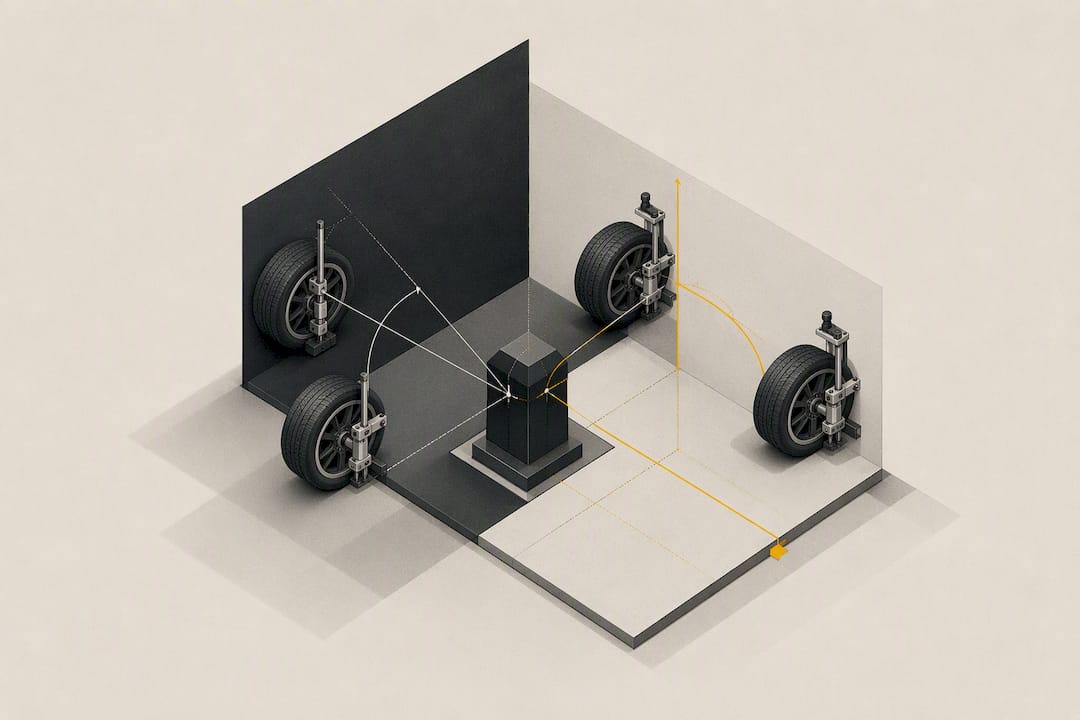
Camera-based alignment systems like the Hunter HawkEye Elite address this with vehicle-specific adapters and calibration routines designed to prevent the undercarriage damage that generic hardware causes on low-clearance cars. These systems pair with precision hub stands that mount directly to the wheel hub, bypassing the tire and suspension entirely so camber and toe readings aren’t skewed by tire sidewall flex or brake rotor runout.
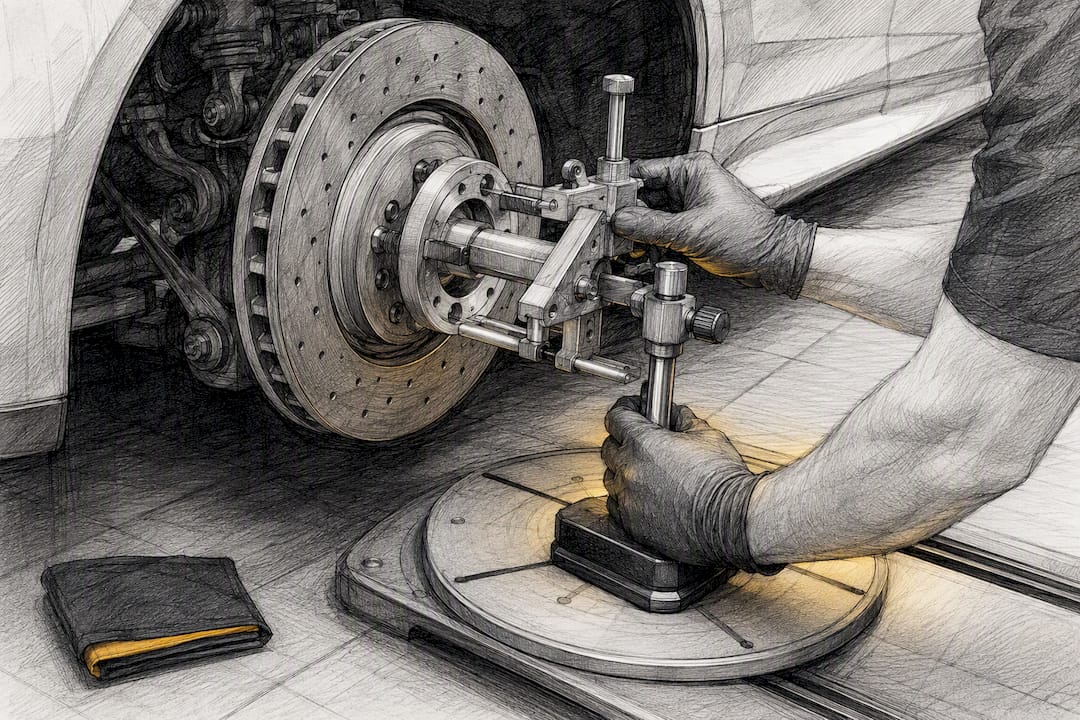
Laser-based systems fill a different niche. Motorsport-oriented laser alignment tools from CSM Performance pair with precision hub stands to give teams repeatable readings in a paddock or home garage, without a full four-post rack. Reporting from Racecar Engineering on emerging alignment tech points to a broader shift toward portable, vehicle-specific tools built to solve exactly this clearance problem on low, wide performance cars.
Generic kits fail on exotics for three concrete reasons:
- Clearance: stock ramps and turnplates aren’t tall or wide enough to clear splitters, side skirts, and diffusers.
- Bolt patterns and hub bore: many supercars use centerlock or nonstandard bolt circles that off-the-shelf adapters don’t fit.
- Track width: rack spacing designed for a 60-inch track can’t accommodate a 65 to 67 inch supercar without forcing the tires against the guide rails.
Ask any shop three questions before booking: what adapters do they stock for your specific make and model, when was the rack last calibrated, and does their software carry OEM ride-height and specification data for your car. If they hesitate on any of the three, keep calling.
The Step-by-Step Alignment Process for High-Performance Cars
A repeatable alignment follows a fixed sequence, not a guess-and-check approach. Skipping steps is how a car leaves the shop measuring correctly on paper but feeling wrong on the road.
Pre-alignment checks:
- Inspect suspension bushings, ball joints, and tie rod ends for play. Worn components make any alignment number temporary.
- Check tire condition and set cold pressures to the target spec before measuring anything.
- Torque all wheels to factory spec. Uneven torque can tilt a wheel enough to skew the reading.
- Determine ride-height targets from OEM or aftermarket coilover specs, and record baseline corner weights before making any adjustments.
Measurement and correction order:
- Correct the rear toe and thrust line first, if the rear is adjustable. Every front adjustment references this rear baseline.
- Set ride height and corner weights next, since changing ride height changes the effective load each wheel carries, which shifts measured camber and toe even if nothing else moved.
- Set front toe and camber last, once the rear and the chassis balance are locked in.
- Check the steering wheel position and confirm it reads dead center at ride height.
Cars with forward-facing cameras or radar tied to ADAS need one more check before you touch anything: some manufacturers require recalibration once suspension geometry changes exceed a defined threshold. Ignoring this step can leave lane-keeping or automatic emergency braking systems reading a false road angle.
Verification is not optional. Drive the car on a straight, flat road and confirm it tracks true with no wheel correction needed. Recheck corner weights after the road test, since settling can shift numbers slightly. Document the final printout with photos, both for your own records and for the next shop that touches the car.
Reading Tire Wear and Steering Cues Before You Call a Shop
Your tires are the most honest diagnostic tool you own, and they’ve been recording alignment problems since the day you bought them.
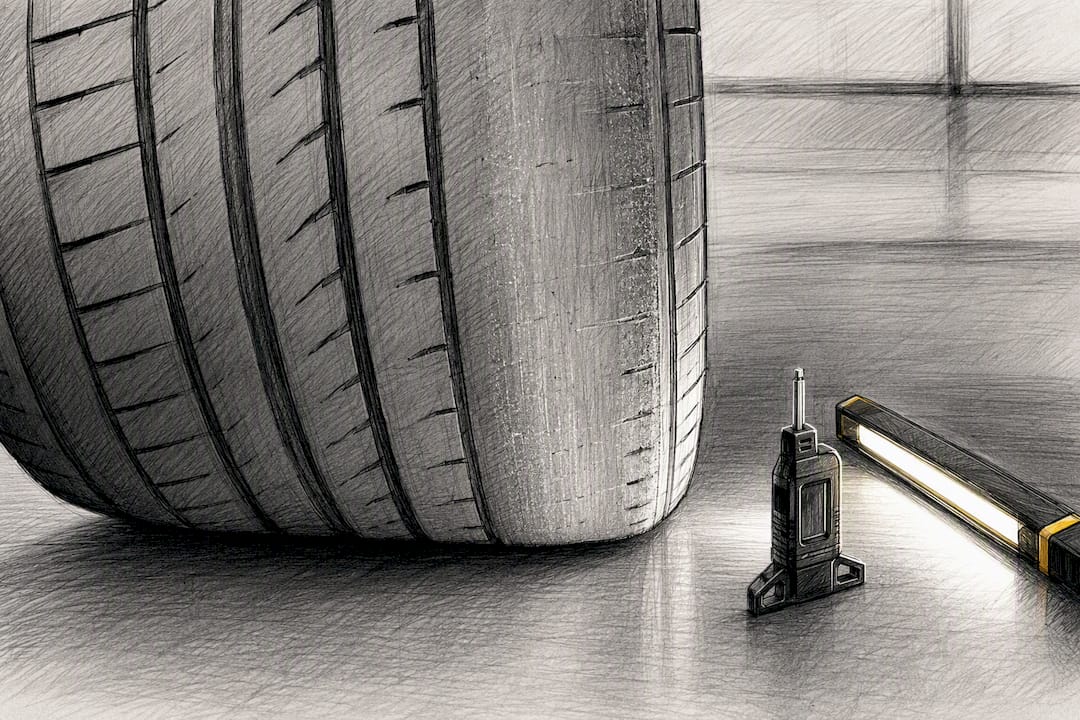
Inner-edge wear across the tread points to excessive negative camber. Feathering, where the tread blocks feel sharp on one side and rounded on the other when you run a hand across them, is the classic signature of a toe problem, a wear pattern confirmed by Intrax Racing’s technical breakdown of scrub-force wear. Cupping, an uneven scalloped pattern around the tire’s circumference, usually means worn dampers or bushings rather than alignment, and no amount of re-aligning fixes it until the suspension component is replaced.
Handling symptoms map to specific faults just as reliably:
- Pulling to one side on a flat road often signals uneven caster or camber between the left and right front.
- An off-center steering wheel almost always traces back to toe or thrust angle, not camber.
- Nervous, twitchy steering at speed frequently comes from excess toe-out, which reduces straight-line stability in exchange for sharper turn-in.
Pirelli’s alignment guidance recommends a simple owner check: park on level ground, walk around the car, and run a bare hand across each tread from inside to outside. A rough, saw-toothed feel in one direction is feathering, and it’s a reliable enough signal to justify booking a four-wheel measurement rather than waiting for the wear to become visible.
The catch: worn tie rods, ball joints, or control arm bushings produce nearly identical symptoms to a bad alignment, and no rack can compensate for a loose component. That’s why a proper inspection always precedes the measurement.
Setting Alignment Targets for Street, Fast Road, and Track Use
Track alignment and street alignment are not the same specification wearing different labels. They’re built around opposite priorities.
Track setups typically add camber, sometimes push toe closer to neutral for reduced scrub on long straights, and occasionally adjust caster to sharpen turn-in response. Street setups favor gentler camber and toe values that spread wear evenly across thousands of daily miles.
Tire compound and track surface change the target numbers, too. A softer track compound at operating temperature grips differently than a street tire cold off the trailer, which is why a setup dialed for one tire brand rarely transfers cleanly to another without adjustment.
- Aggressive camber gains lateral grip but sacrifices tire life fast; conservative setups protect tread at the cost of ultimate lap time.
- Mixed-use owners should lean toward the street side of the range and accept slightly slower laps rather than replacing tires every other event.
- Corner weighting should accompany every track alignment. A car that measures correctly on each wheel individually can still handle asymmetrically if the cross weights are off, and repeatable lap times depend on getting both right together.
How Artec Automotive Approaches a Supercar Alignment
A precision alignment on an exotic isn’t one measurement. It’s a sequence: vehicle-specific adapters that protect the underbody, a calibrated camera-based rack, corner-weight scales, and photo documentation of every setting before and after.
Artec Automotive built its exotic car service around booking ride-height setup, corner weighting, and final verification as one job rather than three separate appointments, because each step depends on the one before it. Splitting them across visits invites the kind of measurement drift that shows up as inconsistent handling weeks later.
Before your appointment:
- Note any recent coilover, spring, or suspension component changes.
- Bring your target specs if you’re chasing a specific track setup.
- Flag whether your car has ADAS cameras or radar tied to ride height.
- Ask for the before-and-after printout and photo record for your files.
What Repeatable Setup Actually Buys You
Predictability is the whole point. A supercar that measures the same on the rack every time is a car whose limits you can trust on a fast on-ramp or a track’s first session of the day, and that consistency is worth more than any single tenth of a degree of extra camber.
DIY alignment tools have their place for a quick toe check between track days, but corner weighting, thrust-line correction, and ADAS-sensitive geometry belong with a specialist every time. Documentation matters more than most owners assume. A photo record of your setup means the next shop, or the next owner, isn’t guessing.
— Artec
Book a Precision Alignment Built for Exotic Geometry
Some providers offer an alternative to generic tire shop racks for supercar wheel alignment in the Bay Area, combining vehicle-specific adapters, corner-weight scales, and calibrated camera-based racks into one documented appointment instead of three separate guesses.

Booking starts with an inspection of suspension components, tire condition, and ride height, followed by rear thrust-line correction, corner weighting, and front toe and camber set to your target specification, whether that’s a factory street setup or a track-focused build. If your car has ADAS cameras tied to suspension geometry, that gets checked before anything is adjusted, not after. Owners with coilovers or modified suspension should also look at custom auto modification support alongside the alignment itself, since setup and modification often need to be coordinated. For classic collector cars with original suspension geometry, the classic car repair team handles the inspection side before any adjustment begins.
Visit the exotic car service page to see what’s included, or reach out to schedule an inspection and get a printout comparison before and after the work is done.
Sources
For deeper technical grounding, Intrax Racing’s camber explainer covers the physics behind each angle. Hunter Engineering’s HawkEye Elite page details camera-based equipment specs, and owners sourcing exotic parts and wheel specifications can check Supercars for reference data.
- Camber and alignment basics — Intrax Racing
- How new tech aims to shake up the wheel alignment market — Racecar Engineering
- Wheel alignment - What is it and why is it important? — Pirelli
- HawkEye Elite alignment machines — Hunter Engineering
FAQ
How much does a full alignment usually cost?
Pricing varies widely by shop and vehicle, since supercar alignments often require specialized adapters and longer labor time than a standard car. Artec Automotive doesn’t publish a flat alignment price online, so current rates are available by contacting the shop directly through its exotic car service page.
What is the most accurate wheel alignment method?
Camera-based systems like the Hunter HawkEye Elite paired with precision hub stands are generally the most accurate approach for exotic cars, because hub-mounted measurement removes tire and rotor runout from the reading. Laser-based portable systems offer comparable precision for shops without a full rack.
What is the ideal camber for racing?
There’s no single universal number. Track camber targets depend on tire compound, track surface, and chassis balance, which is why setups are tuned per car rather than applied from a generic chart. A specialist alignment shop sets camber based on your specific tire and use case rather than a fixed figure.
What are the three types of wheel alignment?
The three core angles measured in any alignment are camber, caster, and toe, as defined in standard alignment fundamentals. Some technicians also refer to “types” as front-only, rear-only (thrust), or full four-wheel alignment, which measures and corrects all axles together for the most accurate result.