
5 Questions to Ask About OEM vs Aftermarket Windshield for ADAS Cars
For ADAS-equipped, newer, or luxury vehicles, OEM (or a verified high-quality OEE panel) is the safer replacement choice because it preserves the camera-zone optical tolerances your safety systems depend on. Older, non-ADAS cars usually do fine with quality aftermarket glass at a lower cost. Either way, the installer’s skill and calibration accuracy matter as much as the glass itself.
TL;DR:
- OEM windshields are highly recommended for vehicles with ADAS features to ensure proper camera calibration and feature functionality.
- Aftermarket glass can be suitable for older, non-ADAS vehicles but may vary in quality and optical tolerances critical for camera zones.
- Proper installation and calibration, including both static and dynamic testing, are essential regardless of glass type, especially for ADAS systems.
- The cost difference is significant, with aftermarket glass typically being 20 to 50% cheaper but potentially risking calibration issues if quality is poor.
- Confirm the manufacturer and part number before installation, as OEM usually shows the automaker’s logo on the corner stamp, while aftermarket displays the supplier’s name.
Table of Contents
- OEM vs Aftermarket Windshield: The Quick Comparison
- What Actually Differs Between OEM and Aftermarket Glass
- How ADAS Depends on Windshield Optics
- When Should You Choose OEM Over Aftermarket?
- Installation Quality Matters as Much as the Glass
- How to Tell If Your Windshield Is OEM or Aftermarket
- What Windshield Replacement Actually Costs
- Why Artec Automotive Leans OEM for High-End Vehicles
- Get Your Windshield Replaced by Specialists Who Know Exotic and European Cars
- Sources
- FAQ
OEM vs Aftermarket Windshield: The Quick Comparison
Fit, optics, and cost separate these two options long before you get to badge or brand name. Here’s the fast version before we get into the mechanics:
- Fit and tolerances: OEM matches the automaker’s exact specifications; aftermarket tolerances vary by manufacturer.
- Optical clarity in the camera zone: OEM stays consistent through the ADAS viewing area; aftermarket quality swings depending on the supplier.
- Cost: aftermarket glass typically runs 20 to 50% cheaper than OEM on mainstream vehicles.
- Insurance: most comprehensive policies default to aftermarket unless your policy carries an OEM parts endorsement.
- The general rule: ADAS-equipped or luxury cars lean OEM; older cars without cameras can usually go aftermarket without much risk.
Neither option is automatically “better.” The right call depends on what your windshield has to do beyond keep out the wind.
What Actually Differs Between OEM and Aftermarket Glass
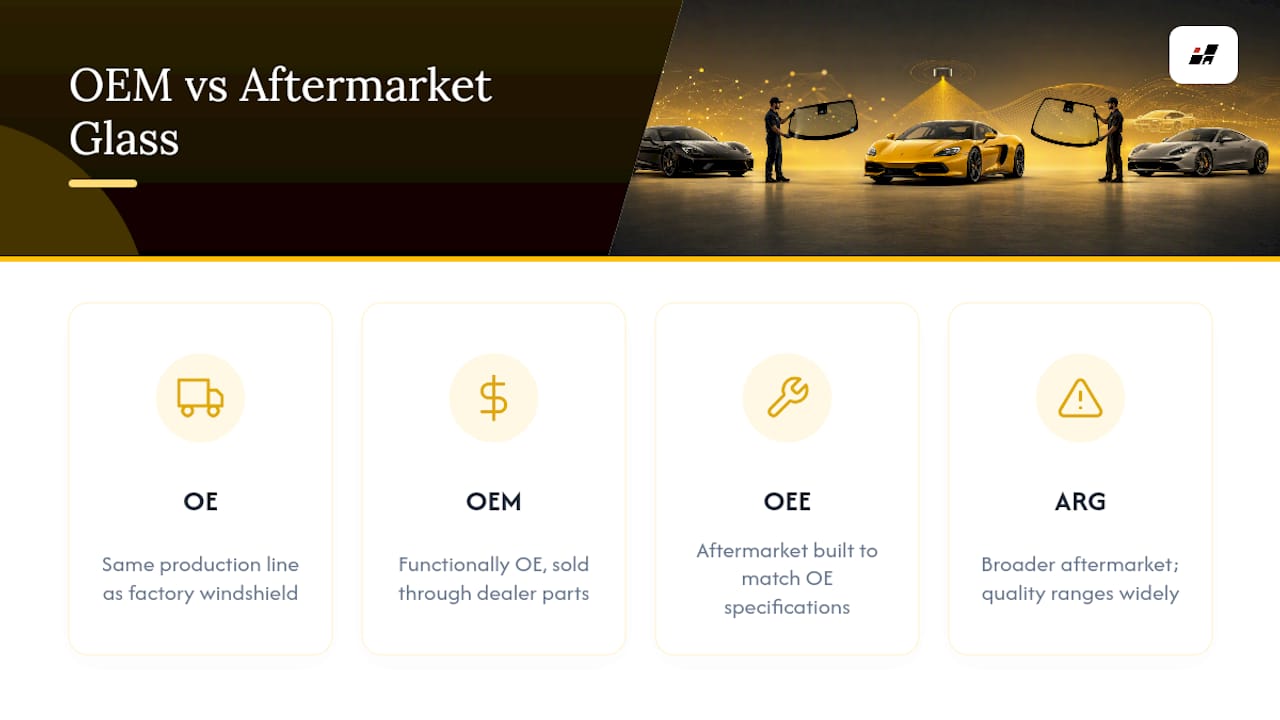
The terminology alone trips up most car owners. OE (Original Equipment) glass comes off the same line as your factory windshield, often from the same supplier under contract to the automaker. OEM (Original Equipment Manufacturer) is functionally the same thing sold through the dealer parts channel. OEE (Original Equipment Equivalent) is aftermarket glass built to match OE specifications, sometimes by the very same manufacturer under a different label. ARG (Aftermarket Replacement Glass) is the broader aftermarket category, with quality that ranges from excellent to genuinely poor.
The differences that matter rarely show up to the naked eye. Curvature tolerances, glass thickness, and bracket placement can vary by fractions of a millimeter between OEM and lower-tier aftermarket panels. That sounds trivial until you remember your forward-facing camera is calibrated to see the road through that exact piece of glass at that exact angle.
Feature mismatches cause the more common complaints. Acoustic interlayers that quiet cabin noise, heads-up display zones that project instrument data without ghosting, heated wiper parks, and camera brackets molded to precise positions are all things a cheap aftermarket panel might simply omit or approximate. OEM glass is built to the automaker’s original specifications, which is why it replicates these features reliably.
It’s worth remembering that FMVSS 205 sets the federal safety floor covering impact resistance and basic visibility for all glazing sold in the United States. Both OEM and aftermarket windshields have to clear that bar. But FMVSS 205 says nothing about whether a panel matches your specific vehicle’s camera geometry or HUD projection zone. Meeting federal safety standards and meeting your car’s ADAS tolerances are two different tests entirely.
How ADAS Depends on Windshield Optics
Your forward-facing camera, lane-keeping system, and automatic emergency braking (AEB) all look through the windshield to do their jobs. That makes the glass itself part of the sensor system, not just a barrier between you and the weather.
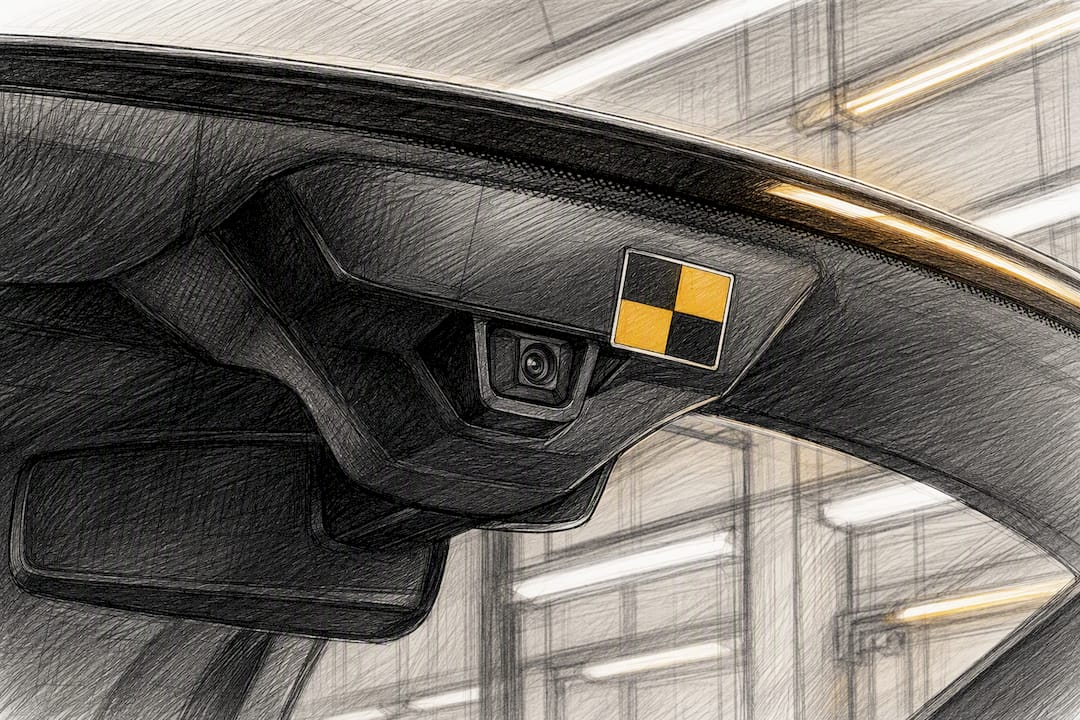
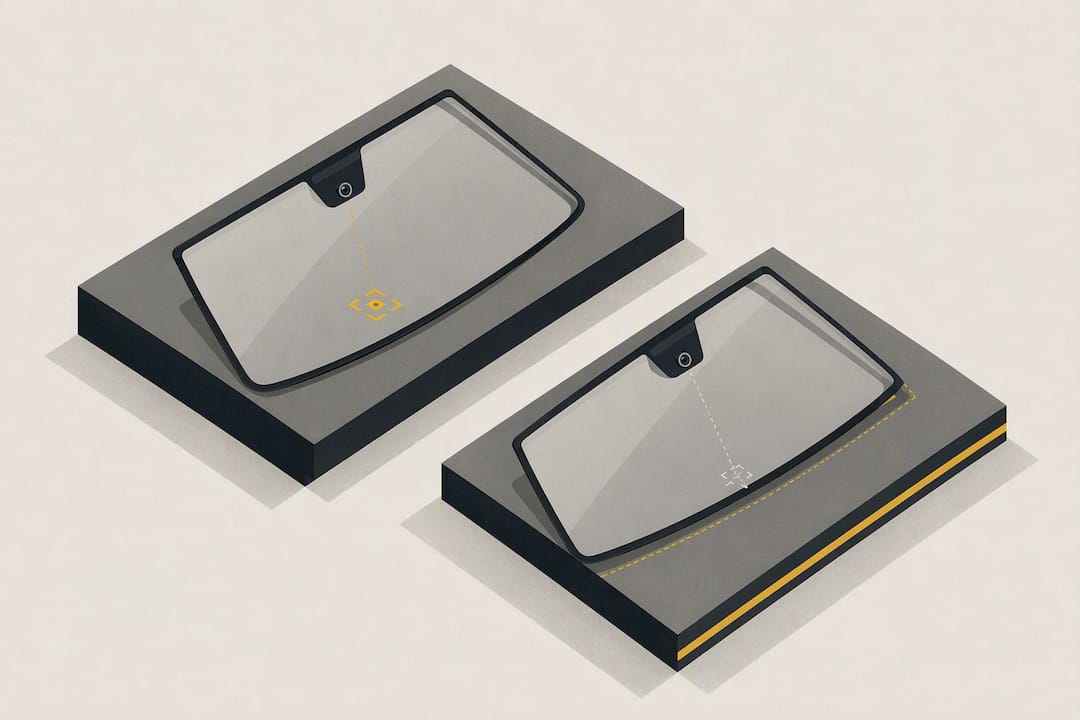
Calibration comes in two forms. Static calibration happens in the shop with targets placed at exact measured distances, teaching the camera where “straight ahead” is relative to the new glass. Dynamic calibration requires driving the vehicle at specific speeds so the system can fine-tune itself against real road input. Many vehicles require both.
Warning signs of a bad calibration or distorted optics include phantom lane-departure alerts, AEB warnings on a clear road, or a lane-keeping system that drifts before correcting. Technicians and industry analyses report cases where calibration fails repeatedly on aftermarket glass and only resolves once OEM glass goes in, which points to bracket position or optical clarity as the root cause rather than a software glitch.
- Verify the shop performs both static and dynamic calibration if your vehicle requires it.
- Ask to see the calibration report, not just a verbal “it’s done.”
- Confirm bracket placement wasn’t shimmed or adjusted to force a fit.
Pro Tip: If your ADAS warnings return within a week of a windshield replacement, don’t assume it’s a fluke. Sub-millimeter optical or bracket offsets can pass a static calibration test in the shop and still fail once you’re actually driving.
When Should You Choose OEM Over Aftermarket?
Run through this checklist before you approve a replacement:
- Does your car have ADAS? Forward-facing cameras, lane-keeping, or AEB raise the stakes considerably. Vehicles built after roughly 2016 are increasingly likely to carry these systems, which is why many technicians use that year as a rough dividing line for recommending OEM.
- Is the vehicle leased or nearing lease return? Lease agreements often specify OEM parts, and a mismatched windshield can turn into a return inspection headache.
- Is this a luxury or exotic model you plan to keep? Preserving factory optics and features protects both resale value and day-to-day system reliability.
- Does your insurance policy include an OEM endorsement? If not, you may need pre-approval or be on the hook for the price difference yourself.
- Have you priced the hidden costs? Repeat calibration visits, wind noise from a poor seal, or a distorted HUD image can erase whatever you saved upfront.
None of this means aftermarket is a bad word. Top-tier aftermarket brands frequently perform close to identical to OEM on mainstream, non-ADAS vehicles. The risk concentrates in unnamed, bargain-bin panels, not the aftermarket category as a whole.
Installation Quality Matters as Much as the Glass
Even a perfect OEM windshield fails if it’s installed poorly. The urethane adhesive bonding the glass to your frame comes in different cure-speed formulations, and each has a manufacturer-specified drive-away time before the bond reaches safe structural strength. Rushing that window compromises crash performance regardless of glass quality.
A competent shop checks its own work afterward. That means a water test for leaks, a wind-noise check at highway speed, and full verification that ADAS systems recalibrated correctly rather than just clearing an error code.
- Ask for documented calibration steps, not a verbal confirmation.
- Confirm the technician has manufacturer-specific ADAS calibration training.
- Walk away from any shop that won’t name the glass manufacturer it’s installing.
- Treat vague warranty terms on the glass or the installation as a red flag, not a minor detail.
Pro Tip: Ask the shop directly: “What’s your drive-away time on this urethane, and how do you verify calibration passed dynamically, not just statically?” A shop that answers confidently and specifically is one you can trust with a six-figure car.
How to Tell If Your Windshield Is OEM or Aftermarket
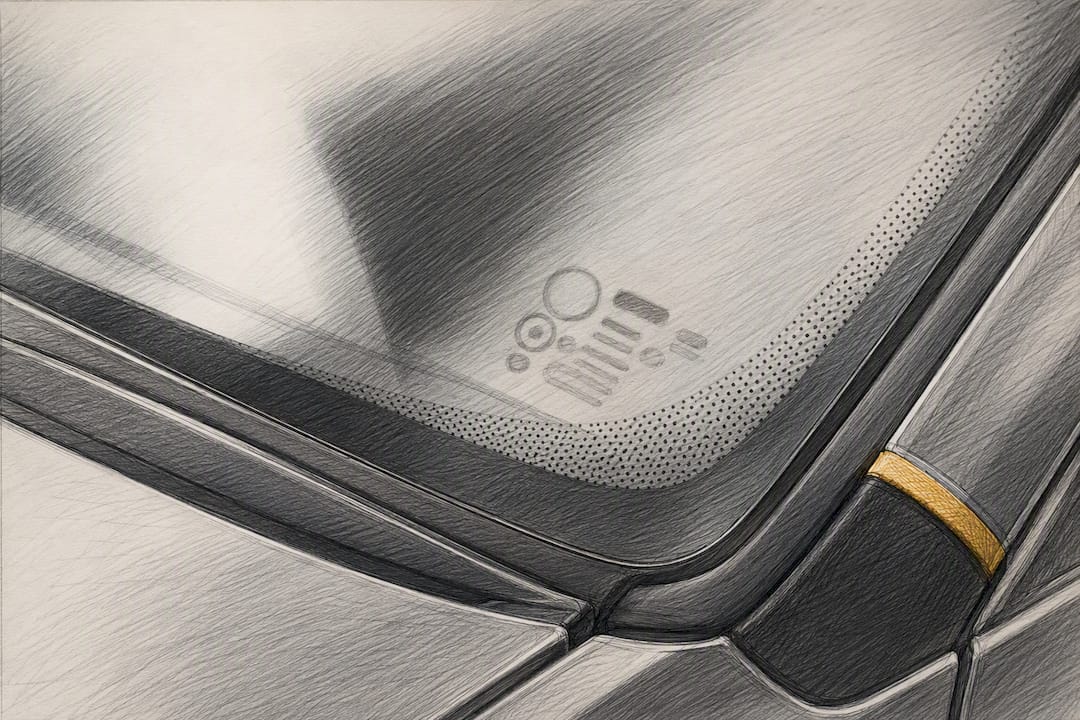
Every windshield carries a corner stamp with a DOT number and manufacturer code, which is your first checkpoint. OEM glass typically shows the automaker’s logo or name molded directly into that stamp; aftermarket glass shows the parts manufacturer’s name instead, which isn’t inherently bad but tells you what you’re getting.
Before installation, ask the shop two direct questions: which glass brand or manufacturer are they using, and what’s the part number? A shop that hedges or won’t disclose the manufacturer is a red flag, not a formality. Bracket material and mounting hardware can also differ visibly between OEM and lower-tier aftermarket parts, even when the glass itself looks similar.
What Windshield Replacement Actually Costs
Price gaps vary more by vehicle class than by geography. On mainstream sedans and crossovers, aftermarket glass generally costs 20 to 50% less than OEM. On luxury models and EVs with camera-dense windshields, that OEM premium can run several hundred dollars higher, driven largely by the complexity of the features embedded in the glass itself.
Your deductible often decides the real math. If your policy defaults to aftermarket and you want OEM, you may be paying the difference out of pocket unless your policy carries an OEM endorsement. Paying more upfront can still be the cheaper path overall when it avoids repeat calibration visits or a system that never quite works right.
- Ask your insurer directly whether your policy includes an OEM parts endorsement.
- Confirm whether ADAS calibration is billed separately from the glass itself.
- Get the shop’s calibration failure/warranty policy in writing before authorizing work.
Why Artec Automotive Leans OEM for High-End Vehicles
Artec Automotive has experience working on ADAS-equipped luxury and exotic vehicles where a windshield isn’t just glass, it’s part of a sensor suite. For models from Porsche, Mercedes, BMW, and similar marques, many shops recommend OEM or a verified high-quality OEE supplier, because the calibration risk and resale implications of getting it wrong outweigh the modest savings aftermarket offers. Clients may be asked for their VIN and current ADAS feature set upfront, and vehicle owners should ask shops the same two questions: which manufacturer, and how is calibration verified.
Owners managing a broader luxury vehicle care routine will recognize this same principle: precision now saves money and headaches later.
— Artec
Get Your Windshield Replaced by Specialists Who Know Exotic and European Cars
A big-box glass shop can swap a windshield fast, but speed isn’t the priority when your car’s cameras, HUD, and bracket tolerances all have to land exactly right. Some shops specialize in exotic, classic, and European vehicles, providing windshield replacement services with attention to ADAS calibration and factory-spec fit comparable to restoration and performance work.
Owners of Ferrari, Porsche, Lamborghini, Bentley, Tesla, or other European or exotic vehicles may want to ensure windshield replacement is done correctly the first time. Reach out to Artec Automotive to discuss your vehicle’s windshield needs and get a straight answer on whether OEM or verified aftermarket glass fits your car and your budget.
Sources
- National Highway Traffic Safety Administration (NHTSA)
- Glass
- Windshield Advisor — OEM vs Aftermarket Windshields: Complete Guide
FAQ
Will Safelite Use OEM Windshields?
Large glass chains, including Safelite, typically install OEM glass when a customer requests it or when insurance authorizes it, but their default stock often skews toward aftermarket or OEE glass unless you specify otherwise.
Should I Replace My Windshield With OEM?
If your vehicle has ADAS features like a forward-facing camera, lane-keeping, or AEB, OEM or verified high-quality OEE reduces the risk of calibration problems; older vehicles without these systems generally do fine with quality aftermarket glass.
How Can I Tell If a Windshield Is Aftermarket?
Check the corner stamp for the manufacturer’s name. If it shows the automaker’s logo, it’s likely OEM; if it shows a separate glass company’s name, it’s aftermarket, and you can ask the shop to confirm the specific brand.
Is It Okay to Use an Aftermarket Windshield?
Yes, for most vehicles without ADAS or with older, less camera-dependent systems, a quality aftermarket windshield from a reputable manufacturer performs nearly identically to OEM at a lower cost.