
Save 30–60% or Risk Rework: OEM vs Aftermarket for Enthusiasts
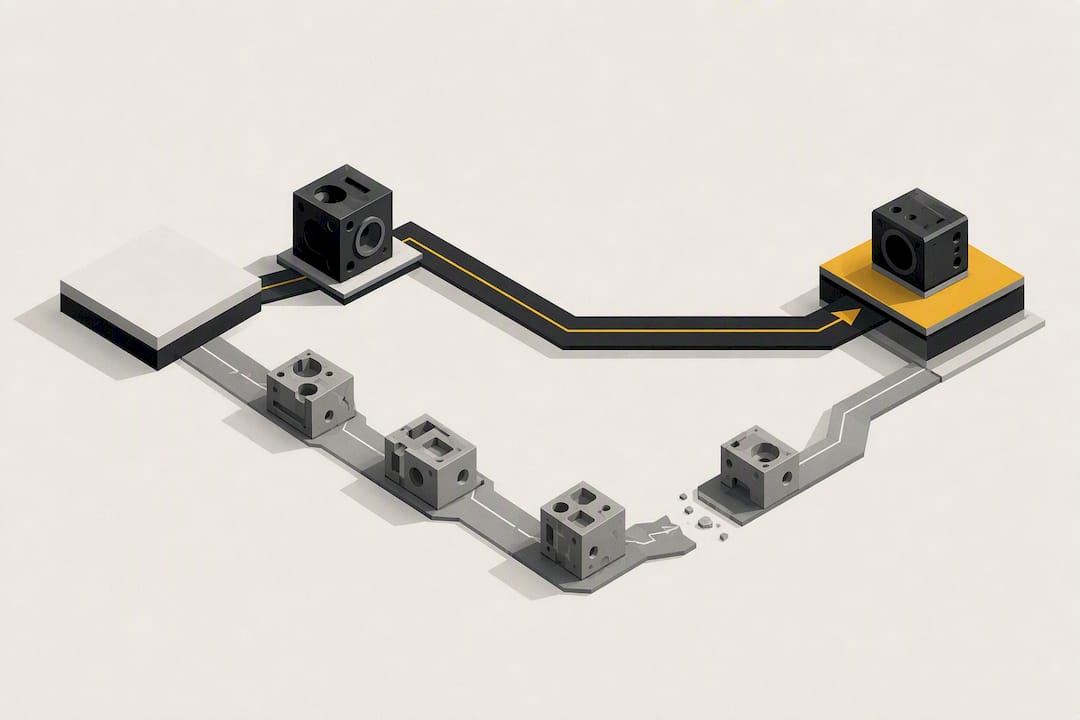
OEM parts are the right call for anything safety-critical, anything tied to a warranty or lease, and anything that touches resale value on a high-end car. Quality aftermarket or tier-one supplier parts make sense for routine wear items, older vehicles, and repairs where cost matters more than dealer branding. The exceptions that override cost savings every time: airbags, ADAS sensors, structural components, and any part where certification and traceability can’t be verified.
TL;DR:
- OEM parts are essential for safety-critical components, structural parts, and repairs under warranty or lease to ensure proper traceability and safety.
- Quality aftermarket parts can be cost-effective on routine wear items, but small deviations in non-OEM components may cause failures within 12 to 18 months.
- Always verify aftermarket parts with VIN-based matching, traceability, CAPA certification, and manufacturer markings to avoid counterfeit or incompatible components.
- Insurers often prefer aftermarket parts for cost reasons unless OEM parts are explicitly mandated, and requests for OEM coverage should be made before repairs begin.
- For high-value or collector cars, OEM parts and professional calibration are recommended to maintain resale value and ensure safety and proper function.
Table of Contents
- OEM vs Aftermarket Parts: What Each Term Actually Means
- OEM vs Aftermarket Quality: Comparing Price, Fit, and Safety
- What Warranty Law and Insurers Actually Require
- When OEM Makes Sense and When Aftermarket Does
- How to Vet an Aftermarket Part Before You Approve It
- How a Specialist Shop Actually Makes This Call
- Our Take: Default to Caution, Not to Cost
- Get Your Parts Sourced and Documented Right the First Time
- Sources
- FAQ
OEM vs Aftermarket Parts: What Each Term Actually Means
OEM (Original Equipment Manufacturer) parts are built by or for the automaker, sold under the automaker’s brand, and packaged through dealer channels. OEM-supplier parts come from the same factories, made by tier-one manufacturers like Bosch, Denso, and ACDelco, but sold under the supplier’s own name instead of the automaker’s. These are frequently the identical component minus the dealer box and markup.
Quality aftermarket parts come from independent manufacturers meeting or exceeding OE specs, often the same companies (Bosch, Denso, ACDelco, NGK, Mann, Wix, Akebono, Brembo) selling into both channels. Budget aftermarket parts cut corners on materials or tolerances to hit a price point. Counterfeit parts copy branding without any of the engineering behind it, and they carry real safety risk with zero traceability.
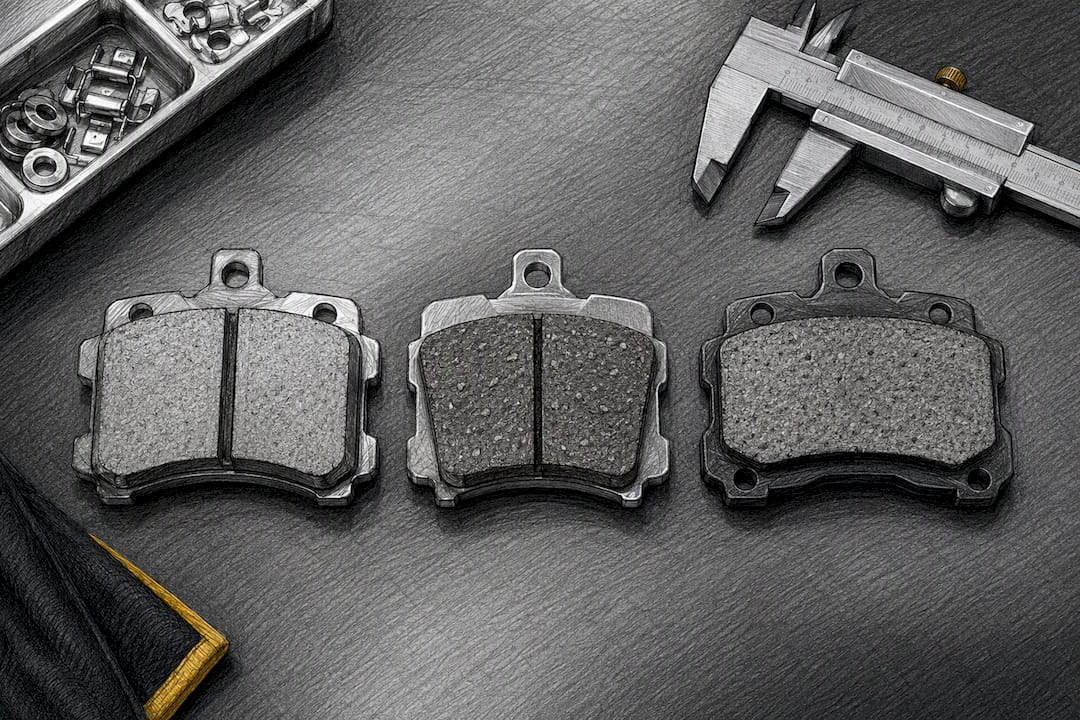
The practical difference between these tiers often comes down to packaging and paperwork, not metallurgy.
OEM vs Aftermarket Quality: Comparing Price, Fit, and Safety
Price is where aftermarket wins most visibly. Quality aftermarket parts commonly run 30 to 60 percent less than OEM, and the gap can be dramatic on specific items. ValuePenguin’s own example: an aluminum bumper reinforcement bar priced at $1,155 OEM versus $181 aftermarket for the same vehicle.
Quality doesn’t split as cleanly along OEM/aftermarket lines as people assume. Filters, brake pads, and bulbs from tier-one brands frequently match or beat OEM performance, since the same suppliers often build both versions. Airbags, calibrated sensors, and structural body panels are a different story. The FS-Elliott analysis of precision components found that small deviations in materials or tolerances in non-OEM parts tend to surface as failures 12 to 18 months after installation, not immediately, which makes the savings look better on installation day than they do two years later.
Fit issues carry their own hidden cost. A bumper or fender that’s close but not exact adds labor hours for trimming, shimming, or refinishing, eating into whatever you saved on the part itself.
One industry analysis found aftermarket collision parts associated with a notably higher secondary repair rate compared to OEM parts in the same category, according to Conquest Auto Parts. That gap can erase the upfront discount fast once a car goes back into the shop.
Other differences worth weighing before you sign off on a repair order:
- Availability: OEM parts on older or lower-volume models can mean backorders lasting weeks; aftermarket alternatives usually ship faster because more suppliers stock them.
- Warranty coverage: OEM parts inherit the manufacturer’s warranty terms; aftermarket warranties vary by brand, typically 12 months to lifetime on wear items, but rarely match OEM’s bumper-to-bumper protection.
- Safety-critical components: Airbags, seatbelt pretensioners, structural crash-rail sections, and ADAS-linked sensors are where OEM remains the conservative, defensible choice regardless of price.
What Warranty Law and Insurers Actually Require
The Magnuson-Moss Warranty Act prevents a manufacturer from voiding your entire vehicle warranty just because you used an aftermarket part. They have to prove that specific part caused the failure being claimed, not just point to its presence under the hood. That protection has limits, though. It doesn’t stop a dealer from denying a single claim once causation is shown, and it doesn’t obligate anyone to cover a part that genuinely failed and damaged something else.
Insurers add another layer. Many carriers default to aftermarket parts on collision estimates to control costs, and several states require insurers to disclose that intent or get owner consent before installing non-OEM parts in a repair. If you want a guarantee of OEM parts, some insurers offer it as a paid endorsement rather than a standard feature.
Pro Tip: Ask your insurer directly whether your policy includes an OEM parts endorsement before a claim happens, not after. It’s usually a modest add-on, and it settles the argument before the shop ever writes an estimate.
Aftermarket parts can run 30 to 60 percent cheaper than OEM, but ValuePenguin’s research also notes that OEM parts help preserve resale value, especially on vehicles where buyers and appraisers expect factory-correct components.
A few practical rules to keep coverage intact:
- Get any aftermarket substitution in writing on the repair estimate before work starts.
- If your car is leased, check your lease terms; some require OEM parts for return condition.
- For appraisals or pre-sale inspections on collector or exotic cars, factory-original parts protect valuation far more than a receipt showing savings.
When OEM Makes Sense and When Aftermarket Does
Match the part to the situation beats defaulting to either camp across the board.
- New car still under warranty. Use OEM. Aftermarket parts won’t void coverage outright, but they invite disputes you don’t need during the warranty window.
- Leased vehicle. Use OEM where your lease terms specify it, particularly for body panels and glass that get inspected at turn-in.
- ADAS and safety systems. Use OEM or a verified-fit aftermarket part paired with professional recalibration. Misalignment here affects how sensors read the road.
- Structural repairs and resale-focused restorations. Use OEM. Buyers of higher-value cars and appraisers both weight factory-correct parts heavily.
- Older, out-of-warranty daily drivers. Quality aftermarket wins on cost with minimal downside for wear items like brakes, filters, and bulbs.
- Performance upgrades. Reputable aftermarket vendors often outperform OEM by design intent, since OEM parts are built to a compromise spec, not a performance one.
The math shifts with vehicle age. A five-year-old commuter car rarely justifies OEM brake pads. A two-year-old car still building resale history almost always does.
How to Vet an Aftermarket Part Before You Approve It
Start with the VIN, not the part number on a shelf. A shop should run your VIN against the OE part number to confirm exact fit before ordering anything aftermarket, since two trims of the same model year can use different components entirely.
- Ask for traceability: batch or lot numbers that let the part be tracked back to its manufacturing run.
- Check for CAPA certification, which verifies collision parts meet independent quality and fit standards.
- Confirm warranty length and the supplier’s return policy in writing, not verbally.
- Ask your mechanic directly: has this supplier been used before, does the part require calibration after install, and will it add labor time?
Pro Tip: Walk away from any part with no visible manufacturer markings, no lot number, and a price that seems too low for the brand name on the box. That combination is the classic profile of a counterfeit part, and customs seizures of counterfeit auto parts have been substantial enough that this isn’t a rare problem.
How a Specialist Shop Actually Makes This Call
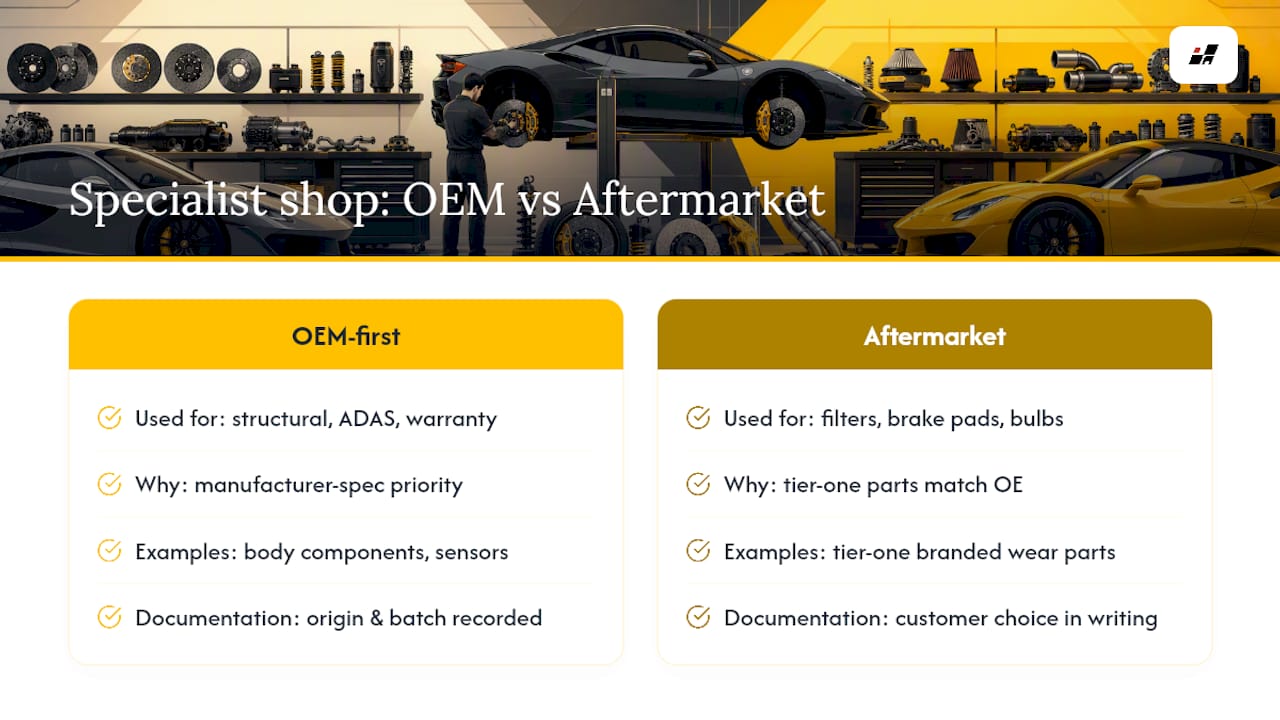
Certain categories are treated as OEM-first by default: structural body components, ADAS-related sensors, and anything on a vehicle still under manufacturer or lease terms. For wear items like filters, brake pads, and bulbs, tier-one aftermarket parts from brands with established OE relationships are standard practice, since the engineering behind them is often identical to what left the factory.
The safeguards matter as much as the sourcing decision. Every install gets documented with part origin and batch numbers, ADAS work goes through professional recalibration rather than an eyeball check, and when a customer chooses aftermarket on a warranty-sensitive repair, that choice gets recorded in writing. Pre- and post-install photos round out the file, which keeps disputes with insurers or manufacturers from turning into he-said-she-said conversations months later.
Our Take: Default to Caution, Not to Cost
The conventional wisdom oversimplifies this into “OEM is safe, aftermarket is risky,” when the real dividing line is criticality, not category. A tier-one aftermarket oil filter is not a gamble. An unverified aftermarket airbag is.
Owners of higher-value or collector vehicles should lean OEM by default and treat aftermarket as an exception you make deliberately, not a habit you fall into for convenience. Insist on VIN-verified parts, keep the paperwork, and loop in a specialist before approving anything on a car whose resale value depends on getting this right.
— Artec
Get Your Parts Sourced and Documented Right the First Time
A specialist shop gives owners of exotic, classic, and European vehicles documented sourcing decisions on every part, not a default to whatever’s cheapest or fastest to order. That means OEM sourcing when the vehicle calls for it, tier-one aftermarket sourcing when it genuinely makes sense, and professional ADAS calibration whenever a sensor-adjacent panel gets replaced.
Every repair comes with the paperwork to back it up: part origin, batch numbers, and installation records that hold up at resale, at appraisal, or in front of an insurer questioning a claim. If your vehicle’s next repair touches anything safety-critical or warranty-sensitive, request an estimate with Artec Automotive before a shop makes that sourcing decision for you.
Sources
- Businessperson’s Guide to Federal Warranty Law (FTC)
- OEM vs Non-OEM Car Parts: Cost, Safety and Insurance Coverage - ValuePenguin
- Aftermarket versus manufacturer car parts - Edmunds
- OEM vs Non-OEM Parts: Performance, Risk, and Long-Term Cost - FS-Elliott
FAQ
Does Using Aftermarket Parts Void My Car’s Warranty?
No. The Magnuson-Moss Warranty Act prevents manufacturers from voiding an entire warranty just because an aftermarket part was used. The manufacturer has to prove that specific part caused the failure being claimed.
Are OEM Parts Always Better Than Aftermarket?
Not always. Tier-one aftermarket brands like Bosch, Denso, and NGK often match OEM quality on filters, brake pads, and bulbs, but OEM remains the safer choice for airbags, structural panels, and ADAS-linked sensors.
Will My Insurance Pay for OEM Parts After an Accident?
It depends on your policy and state. Many insurers default to aftermarket parts to control repair costs, and some states require disclosure or owner consent before installing them; OEM parts guarantee is often available only as a paid policy add-on.
How Can I Tell If an Aftermarket Part Is Legitimate?
Check for CAPA certification, ask for batch or lot traceability numbers, and confirm the part number against your VIN before installation. Missing manufacturer markings or an unusually low price are red flags for counterfeit parts.
Does Artec Automotive Use OEM or Aftermarket Parts?
A specialist shop sources OEM parts for structural, warranty-sensitive, and ADAS-related repairs, and tier-one aftermarket parts for routine wear items where the engineering is comparable. Every installation is documented with part origin and batch records for resale and insurance purposes.