

Avoid Surprise Bills: Mercedes Service A and B and Your VIN Checklist
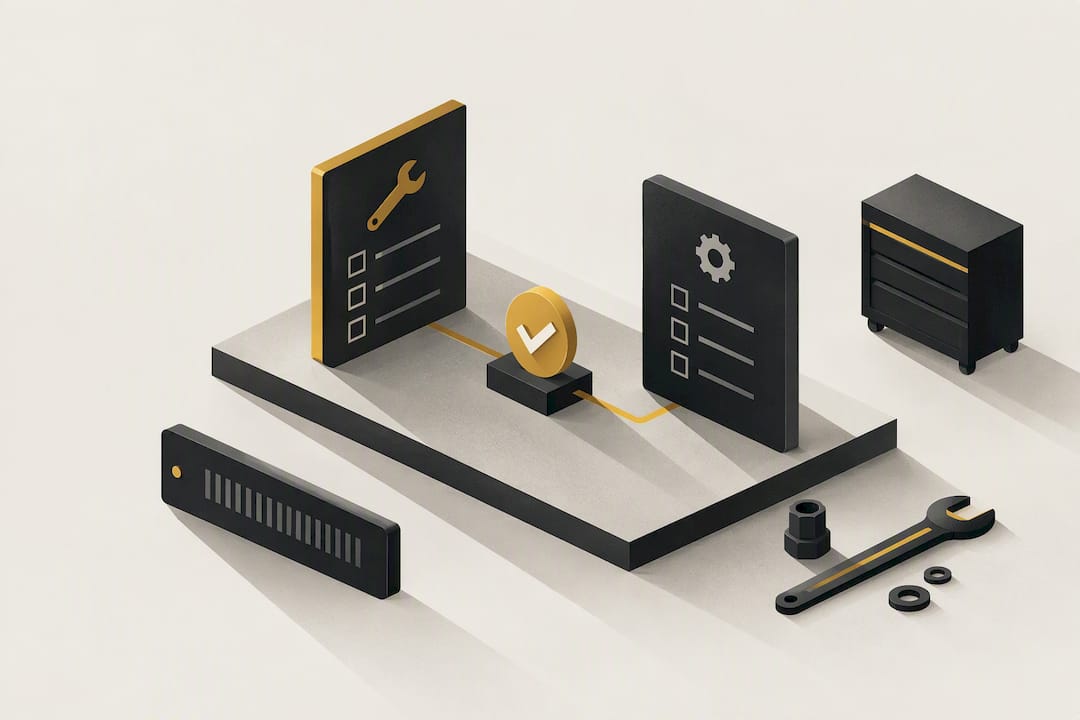
Mercedes Service A is the baseline scheduled maintenance visit, mainly a synthetic oil change and a round of inspections, due at roughly 10,000 miles or one year. Service B carries all of that plus a cabin/combination filter replacement and a brake-fluid exchange, due at roughly 20,000 miles or two years. Which one applies to you and exactly what it includes depends on your car’s maintenance system and its VIN, so the printout from your advisor is the final word.
TL;DR:
- Service A includes an oil change, filter replacement, fluid checks, brake inspection, and tire pressure correction, with exact items depending on your VIN.
- Service B adds a cabin filter replacement and a brake-fluid exchange, which take longer and cost more due to extra labor involved.
- The timing of services depends on your vehicle’s maintenance system, which considers both miles driven and time elapsed, and can vary for AMG, diesel, hybrid, or EV models.
- Owners should request a VIN-specific checklist before any service to avoid overpaying or missing necessary repairs, especially for model-specific or early maintenance items.
- Independent specialists like Artec Automotive can conduct scheduled maintenance with transparent estimates and documentation, often more precisely tailored than dealership options.
Table of Contents
- Mercedes Service Schedule: How A and B Alternate
- What Does Mercedes Service A Include?
- What Does Mercedes Service B Add?
- How Do Model and VIN Change the Service Interval?
- Mercedes AMG Maintenance Cost and General Service Pricing
- Scheduled Maintenance vs. Separate Repairs on Your Invoice
- Handling VIN-Specific Service Without Surprises
- What Owners Get Wrong About A and B Service
- Book Your Mercedes A or B Service with Artec Automotive
- Where to Verify Your Mercedes Service Requirements
- Sources
- FAQ
Mercedes Service Schedule: How A and B Alternate
The rhythm most owners see is straightforward: Service A lands first at around 10,000 miles or one year, Service B follows at around 20,000 miles or two years, and the two then alternate every 20,000 miles or two years after that. Mercedes-Benz doesn’t run this off a rigid calendar. The ASSYST maintenance system tracks both elapsed time and miles driven, weighs how the car has actually been used, and calculates a due point that can shift earlier for a car driven hard or later for one that sits more.
Owners typically get a dashboard warning roughly a month before the service is due, showing remaining days or miles. That’s your real trigger, not a spreadsheet. A few groups run on a different rhythm entirely:
- AMG models often need different oil specs and can call for earlier attention to brake and cooling components.
- Diesel and V12 engines carry their own filter and fluid requirements.
- Hybrid and EV variants swap traditional service items for high-voltage battery and cooling-system checks.
- Certain model years add or drop specific line items even within the same A or B designation.
What Does Mercedes Service A Include?
Service A is built around three jobs: refresh the engine’s lifeblood, check what wears fastest, and log that it happened. That third piece matters more than owners often realize, since a missed reset or unrecorded visit can complicate a warranty claim down the road.
- Motor-oil replacement using a Mercedes-approved synthetic oil matched to your engine’s specification.
- Oil filter replacement, done at the same time as the oil change.
- Fluid level checks and corrections across coolant, washer fluid, and other core systems.
- Brake-component inspection to catch pad wear or hardware issues early.
- Tire inflation check and correction to keep wear even and readings accurate.
- Maintenance counter reset, plus a service entry in the Digital Service Booklet or a printed service record.
That list is the common baseline, not a guarantee for your specific car. Model year, engine, and trim can add or subtract items, which is exactly why the VIN-specific checklist matters more than any generic chart.
Pro Tip: Ask your advisor to pull up the VIN-specific due list before you approve the ticket. It takes them thirty seconds and it settles any question about what’s actually being paid for.

What Does Mercedes Service B Add?
Service B starts with everything in Service A, then layers on two items that don’t need attention every year: cabin/combination filter replacement and a full brake-fluid exchange. That’s the whole difference on paper, but it’s the reason B tends to run longer and cost more.
Brake fluid is hygroscopic, meaning it slowly absorbs moisture from the air over time. Moisture lowers the fluid’s boiling point and invites corrosion inside brake lines and calipers, which is why Mercedes schedules a full exchange rather than a top-off. The cabin filter matters for a less dramatic but still real reason: a clogged filter cuts airflow through the HVAC system and lets more outside particulates into the cabin.
- Brake-fluid exchange requires draining and refilling the system, sometimes with a bleed procedure.
- Cabin filter replacement is quick but still adds parts and labor on top of A’s scope.
- Both items appear on top of every Service A task, not instead of them.
Mercedes-Benz’s own service guidance notes that a B visit can run past 60 minutes, longer than a typical A appointment, largely because of the extra hands-on work brake-fluid evacuation and filter access require. Confirm your VIN-specific B checklist with your advisor before assuming the standard list applies word for word.
How Do Model and VIN Change the Service Interval?
Your maintenance system, not a printed brochure, decides when service is due. It calculates the interval from actual mileage and elapsed time, then displays a countdown in days or miles on the dashboard. That number is the authoritative due point for your specific car, and it can move earlier or later than the “nominal” 10,000/20,000 mile figures depending on how the vehicle is driven.
Model-specific variation is where a lot of owners get surprised. AMG, diesel, V12, hybrid, and EV variants can carry different required items or different intervals than the standard gasoline lineup, and certain model years insert extra checks that don’t appear on older or newer versions of the same nameplate.
Before any wrench touches the car, it’s worth doing two things:
- Ask for a VIN-specific confirmation of exactly which items are due this visit.
- Have the advisor print or screen-share that list so you can compare it against the invoice later.
Mercedes AMG Maintenance Cost and General Service Pricing
There’s no single number that applies across the lineup. Invoice totals shift with your VIN and model, the oil capacity and spec your engine requires, filter type, regional labor rates, and anything the inspection turns up that wasn’t already on the scheduled list. Two owners with the “same” C-Class can get different quotes if their VINs call for different oil specs.
A few patterns hold up consistently:
- Service A is generally the quicker, lower-cost visit of the two.
- Service B, with its added filter and brake-fluid work, commonly costs more and runs longer, sometimes past the 60-minute mark.
- AMG maintenance cost and other high-performance service pricing typically climbs higher than standard trims, since these engines often need specialized oils, unique parts, and more complex labor.
The one move that protects you from sticker shock is asking for a written, VIN-specific estimate up front, and having your advisor separate what’s scheduled from what’s merely recommended.
Scheduled Maintenance vs. Separate Repairs on Your Invoice
Not everything on a service invoice is part of A or B. Brake pads and rotors, tires, batteries, wiper blades, spark plugs, engine air filters, and transmission work typically live on their own mileage-based schedules and get billed as separate line items, even when they’re recommended during the same visit. Treating the A/B chart as a complete maintenance plan is a common and expensive mistake, since several of the priciest components run on different clocks entirely.
- Request a VIN-specific service confirmation, digital or printed, showing what was scheduled versus what was recommended.
- For any recommended add-on, ask for photos, a parts list, and a plain-language explanation before signing off.
- Keep every receipt and confirm the visit was logged in the Digital Service Booklet, since documented maintenance history matters if you ever file a warranty claim.
Pro Tip: If a shop flags brake dust buildup as a “repair,” ask whether it’s genuinely worn hardware or just surface residue that cleans off without parts replacement. It’s a common upsell moment.
Handling VIN-Specific Service Without Surprises
The single best habit an owner can build is asking to see the VIN-specific due-items list before any work starts, not after. That one request settles most disputes before they happen, because it tells you exactly which factory-scheduled tasks apply to your car instead of the generic chart.
VIN surprises are more common than most owners expect. Some models call for a unique filter, an extra coolant check, or an earlier part replacement that never shows up on a standard A/B summary. Any time a shop adds a billed item beyond the baseline list, ask for a photo and a plain explanation of why it’s needed now rather than at the next visit.
Warranty-sensitive or emissions-related work generally belongs with an authorized dealer. For deep European and exotic expertise, paired with photo documentation and a written service record, an independent specialist like Artec Automotive can be the stronger choice for day-to-day scheduled maintenance.
Parts sourcing adds another layer of variation. Some components are model-specific rather than universal, which is one more reason a generic price list rarely matches what your particular Mercedes actually needs.
What Owners Get Wrong About A and B Service
The conventional wisdom treats Service A and B like a fixed menu you can memorize once and apply to any Mercedes. That’s the biggest misread in this whole topic. The mileage figures are reliable as a general rhythm, but the actual checklist is a function of your specific VIN, and skipping that step is how owners end up either overpaying for unnecessary line items or underpaying because they missed something their car genuinely needed.
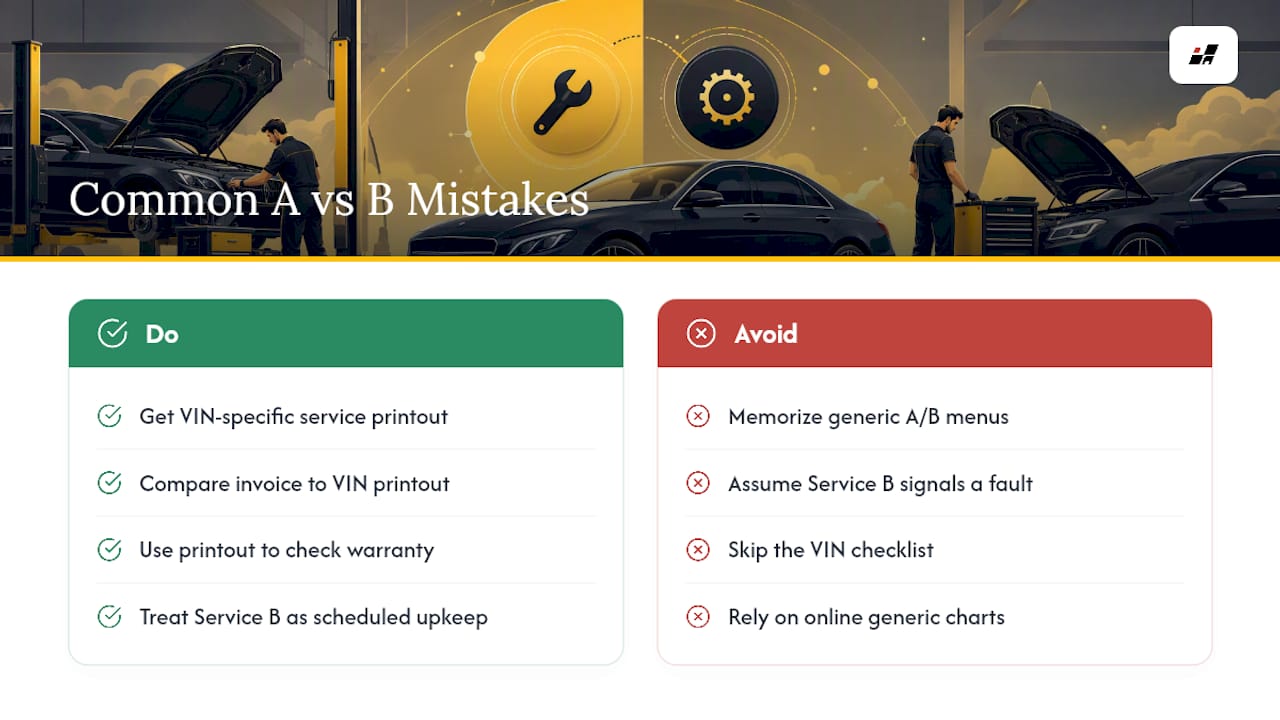
The other overrated idea is that Service B means something is wrong. It doesn’t. It’s scheduled upkeep, not a diagnosis, and the added brake-fluid and filter work exists precisely to prevent problems rather than fix ones already present.
What should come first for any owner: stop comparing your invoice to a generic online chart and start comparing it to your own VIN-specific printout. That single document resolves nearly every question this article covers, from whether an item is scheduled or optional to whether your warranty documentation is intact. Everything else, cost, timing, even the AMG premium, flows downstream from getting that baseline right.
— Artec
Book Your Mercedes A or B Service with Artec Automotive
Dealership waiting rooms and generic quick-lube chains aren’t your only options for factory-scheduled maintenance. Specialist shops can handle Service A and Service B work for Mercedes and other European vehicles with VIN-specific rigor, providing transparency through printed due-items lists, written estimates before starting, and photos of any recommended repair before approval.

When you book European car service with Artec, you get a clear picture of what’s scheduled versus what’s optional, so there’s no guessing at what the invoice actually covers. Every completed job gets recorded for your files, which matters if you ever need to show continuous maintenance history for warranty purposes. If your Mercedes is due for its next A or B visit, schedule automotive repair and service with Artec and get a VIN-specific estimate before any work begins.
Where to Verify Your Mercedes Service Requirements
- Mercedes-Benz USA’s service and maintenance page for official sample checklists and timing notes.
- The Mercedes-Benz Service and Warranty booklet for warranty documentation requirements.
- Your dealer’s service department or a specialist like Artec Automotive for a VIN-specific printout.
Sources
- Service & maintenance — Mercedes‑Benz USA
- Mercedes‑Benz Service and Warranty Information 2025 (MBUSA PDF)
- Mercedes A service and B service cost differences — CarBuzz
- What are the differences between Mercedes‑Benz Service A and B — MB of Newton
FAQ
Which Costs More, Service A or Service B?
Service B generally costs more than Service A because it includes everything in A plus a cabin filter replacement and a full brake-fluid exchange. There’s no fixed price for either service since the total depends on your VIN, oil spec, and regional labor rates, so ask your advisor for a written, VIN-specific estimate.
Do I Really Need Service B?
Yes. Service B isn’t optional upkeep or a sign something’s wrong with your car. It’s scheduled maintenance that replaces brake fluid before moisture buildup lowers its boiling point and swaps the cabin filter before airflow and cabin air quality suffer.
How Often Are Service A and Service B Due?
Service A is typically due at around 10,000 miles or one year, and Service B follows at around 20,000 miles or two years, then the two alternate every 20,000 miles or two years after that. The exact due point comes from your car’s maintenance system, which tracks mileage and elapsed time together rather than running on a fixed calendar.
How Long Does a Service B Take?
A Service B appointment commonly runs longer than 60 minutes, since the added brake-fluid exchange and cabin filter work take more hands-on labor than a standard oil-and-inspection visit. Ask your service advisor for a time estimate specific to your model when you book.
Can Artec Automotive Perform My Mercedes A or B Service?
Yes. Artec Automotive performs factory-scheduled A and B maintenance on Mercedes and other European vehicles, and can provide a VIN-specific due-items list along with a written estimate before starting work. Current pricing for Artec’s services is available directly on the Artec Automotive site.