
60–80% vs 40–60% IR: Ceramic Tint vs Carbon for Exotic Cars
Ceramic tint outperforms carbon on heat rejection and clarity, but carbon still makes sense for garaged cars on a tighter budget. If your vehicle sits outdoors, especially an EV or a car with dark leather, ceramic’s higher infrared rejection pays for itself in comfort. The trade-off comes down to installed cost versus long-term performance and warranty coverage, which the comparison and checklist below break down in detail.
TL;DR:
- Ceramic tint offers significantly higher infrared heat rejection, typically 60% to 80%, compared to carbon’s 40% to 60%, making it more effective for outdoor parking and hot climates.
- Compared to ceramic, carbon tint costs less upfront, usually $300 to $500, but offers a shorter warranty of 5 to 10 years and slightly lower long-term durability.
- Both films block about 99% of UV rays and do not interfere with signals, but ceramic provides sharper optical clarity and better glare reduction, especially useful for night driving.
- The main cost difference lies in installation prices, with ceramic being more expensive due to material properties and longer warranties, which can justify the higher price for long-term protection.
- Proper installation, warranty details, and matching the film to your vehicle’s parking environment and usage are critical for maximizing performance and lifespan.
Table of Contents
- Ceramic Tint vs Carbon: The Quick Comparison
- How Carbon Tint Works and What to Expect
- How Ceramic Tint Works and What to Expect
- Ceramic vs Carbon: A Side-by-Side Performance Breakdown
- What Ceramic and Carbon Tint Actually Cost
- How to Choose Between Ceramic and Carbon Tint
- Installation Quality, Warranty Terms, and Maintenance
- Artec Automotive’s Perspective on Choosing the Right Film
- Get Professional Window Tinting From Artec Automotive
- Sources
Ceramic Tint vs Carbon: The Quick Comparison
The numbers tell most of the story before you even get to installer quotes. Carbon tint typically rejects 40% to 60% of infrared heat, while ceramic films commonly land in the 60% to 80% range. Both film types block roughly 99% of UV rays, so UV protection isn’t the deciding factor here.
Carbon tint at a glance:
- Matte, non-reflective finish that suits dark or matte-trimmed vehicles
- IR rejection typically in the 40% to 60% range
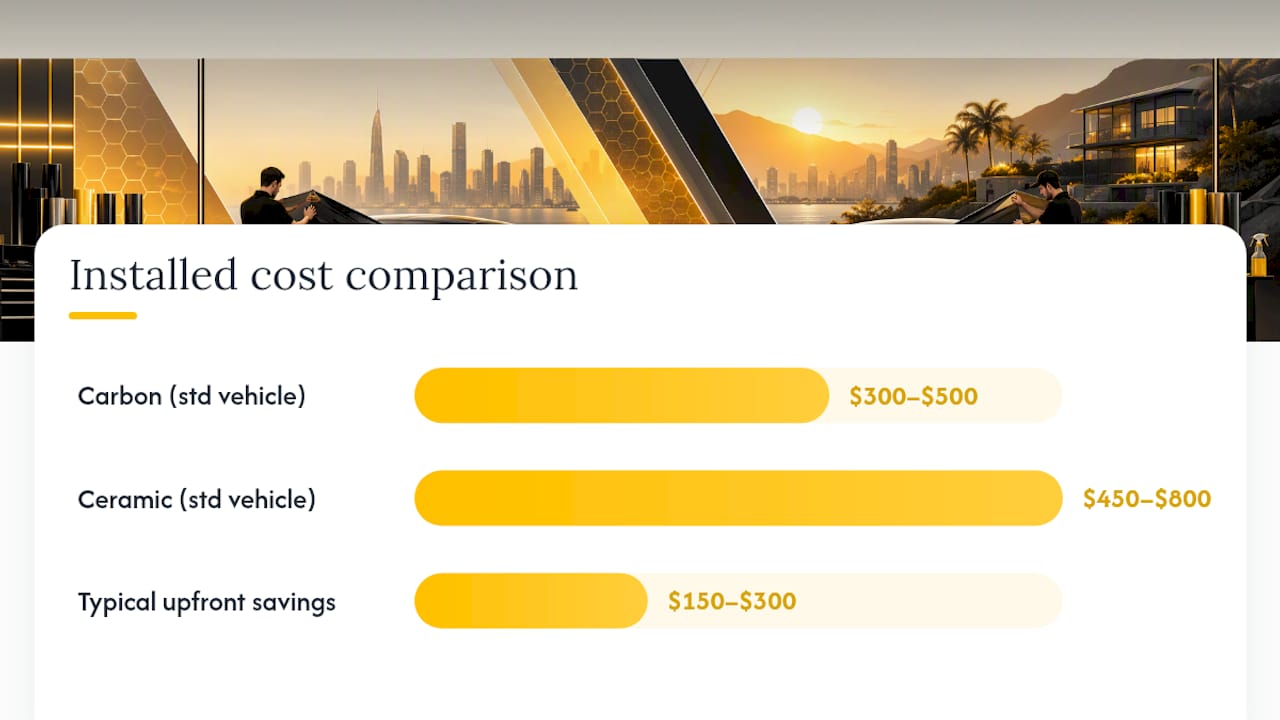
- Installed cost usually runs $300 to $500 for a standard vehicle
- Best fit for garaged cars, budget-conscious owners, and daily commuters
Ceramic tint at a glance:
- Near-neutral color transmission with sharper optical clarity
- IR rejection typically in the 60% to 80%+ range
- Installed cost usually runs $450 to $800 for a standard vehicle
- Best fit for outdoor parking, EVs, and hot-climate driving
The gap in IR rejection is the single biggest reason ceramic costs more. It’s not marketing. It’s physics, and it shows up on a thermometer inside the cabin within minutes of parking in direct sun.
How Carbon Tint Works and What to Expect
Carbon window film gets its name from the carbon particles embedded in its polyester layers, not from any exotic material sourcing. Unlike older dyed films, carbon tint has no metal content, which means it won’t fade to purple over time and won’t interfere with electronics. The carbon particles absorb infrared energy rather than reflecting it, converting some of that heat before it ever reaches the glass surface.
That absorption process is why carbon tint typically delivers 40% to 60% IR rejection. It’s a meaningful step up from dyed film, which mostly just darkens the glass without doing much for heat. But it’s a step below ceramic, which uses a different mechanism entirely to push rejection numbers higher.
What you’ll notice day to day:
- A flat, matte look with no shine, even in bright light
- Some carbon films carry a very slight warm tint compared to ceramic’s neutral gray
- Cabin temperature drops noticeably compared to no tint, though not as much as ceramic
- No signal interference with phones, GPS, or radio, since the film contains no metal
Durability on carbon tint is solid but not indefinite. Most manufacturers back it with warranties in the 5 to 10 year range, covering issues like bubbling, peeling, and adhesive failure. That’s a longer lifespan than old-school dyed film, which tends to fade and bubble well before the 5-year mark, but shorter than what premium ceramic manufacturers typically offer longer coverage.
Carbon tint tends to suit owners who park in a garage most nights, drive a gas-powered car without the added heat sensitivity of EV battery management, and want a clean matte look without paying for ceramic’s clarity premium.
Pro Tip: If you like the matte aesthetic but still want better heat rejection, ask your installer whether their carbon line has a “hybrid” or upgraded ceramic-carbon blend. A few manufacturers now split the difference on both look and performance.
How Ceramic Tint Works and What to Expect
Ceramic film uses nano-ceramic particles instead of carbon or dye, and that distinction changes how the film handles heat at a molecular level. These particles are non-conductive and non-metallic, so they don’t cause the signal problems that older metalized films did, but they’re dramatically better at scattering and absorbing infrared radiation than either carbon or dye.
That’s the whole reason ceramic dominates the heat-rejection conversation. Where carbon tops out around 60% IR rejection, ceramic films regularly land in the 60% to 80% range, and some premium series push past that. On a Tesla or any EV parked outdoors on a summer afternoon, that difference shows up as a cabin that’s noticeably cooler to the touch, not just cooler on paper.
What sets ceramic apart in daily use:
- Optical clarity is sharper, with less visual distortion at night
- Color rendition stays closer to neutral gray rather than shifting warm or dark
- Glare reduction is stronger, which matters for long highway drives
- Fade resistance holds up well over years of UV and heat exposure
The clarity advantage matters more than people expect. Ceramic film’s optical stability makes it the preferred choice for windshield sunstrips and top-band applications, where any color shift or haze would be immediately obvious against clear glass.
Warranty terms reflect the manufacturing confidence behind ceramic film. Many premium brands back their ceramic products with lifetime coverage, a strong signal that the film is built to outlast the vehicle’s ownership cycle rather than just the first few years.
Statistic to keep in mind: shop-conducted thermal tests have shown ceramic-treated vehicles running significantly cooler in cabin temperature than similarly tinted cars using carbon film, particularly after extended sun exposure.
Pro Tip: Don’t just ask “is it ceramic?” Ask for the specific series name and request the manufacturer’s published TSER (Total Solar Energy Rejected) figure. IR rejection claims vary widely between series from the same brand, and the number on the brochure isn’t always the number on your car.
Ceramic tint suits drivers who park outdoors regularly, own an EV where every degree of cabin heat translates to HVAC load, or simply want the best optical experience the film category currently offers.
Ceramic vs Carbon: A Side-by-Side Performance Breakdown
Once you get past the marketing language, four measurable factors separate these films: heat rejection, clarity, longevity, and cost. Here’s how they stack up when you put them next to each other.
| Factor | Carbon | Ceramic |
|---|---|---|
| IR rejection | 40% to 60% | 60% to 80%+ |
| UV protection | ~99% | ~99% |
| Optical clarity | Good, slight warmth | Excellent, neutral |
| Signal interference | None | None |
| Typical lifespan | 5 to 10 years | Often lifetime |
| Installed cost (standard vehicle) | $300 to $500 | $450 to $800 |
Heat rejection is where the two films diverge most sharply. Carbon absorbs a moderate share of infrared energy, while ceramic’s nano-particle structure pushes rejection rates into a different tier entirely. In practical terms, that’s the difference between a steering wheel that’s warm to the touch versus one that’s genuinely hot after two hours in a parking lot.
UV protection is a non-issue in this comparison. Both film types block roughly 99% of UV rays, so if skin protection or interior fade prevention is your main concern, either film gets the job done. Don’t let a shop upsell you on ceramic purely for UV blocking. That argument doesn’t hold up.
Optical clarity favors ceramic, especially at night. Carbon’s slight warm cast and marginally lower light transmission can add a touch of haze under streetlights or oncoming headlights. Ceramic’s neutral color rendition keeps night visibility closer to how the glass looks untinted, which matters if you do a lot of highway driving after dark.
Signal interference isn’t a real concern for either film. Both carbon and ceramic are non-metallic and won’t interfere with GPS, cell signal, or radio reception. That interference problem belongs to older metalized dyed films, and it’s largely why the market moved away from them.
Lifespan and warranty are where installation quality starts to matter as much as material choice. Carbon typically carries 5 to 10 year coverage, while ceramic often comes with lifetime warranties from premium manufacturers. But a poorly installed ceramic film with trapped moisture or lifted edges will fail faster than a well-installed carbon film, regardless of what the warranty paper says. The material sets the ceiling; the installer determines whether you get anywhere close to it.
Cost is the most straightforward trade-off. Carbon saves you $150 to $300 up front on a standard vehicle. Ceramic costs more initially but tends to deliver better long-term value through longer warranty coverage and, for EV owners specifically, reduced HVAC load that can help preserve driving range in hot climates. Whether that premium is worth it depends heavily on how much time your car spends parked in direct sun.
What Ceramic and Carbon Tint Actually Cost
Price ranges only mean something once you connect them to how long the film lasts and what it saves you in comfort. Carbon tint for a standard sedan or SUV typically runs $300 to $500 installed, while ceramic runs $450 to $800 for the same vehicle. Larger vehicles, curved rear windows, and premium film series push both ranges higher.
Warranty coverage is the piece most buyers skip past, and it’s the piece that determines whether that price difference was worth it. Look for warranty language that specifically names bubbling, peeling, adhesive failure, and color fading as covered defects, not just a vague “manufacturer defects” clause. Carbon warranties commonly run 5 to 10 years; many ceramic products carry lifetime coverage from the manufacturer, though that coverage usually requires proof of professional installation.
Payback on ceramic’s higher price tag comes from three places: reduced AC compressor strain in gas vehicles, better cabin comfort that reduces how often you crank the air conditioning to max, and for EV owners, a real (if modest) improvement in range during hot weather because the HVAC system works less to cool the interior.
What to ask before you book:
- What’s the specific film series name, and can you show me its published TSER figure?
- Is the warranty transferable if I sell the car, and does it require proof of professional install?
- What’s your shops install failure rate, and do you stand behind your own labor separately from the film’s warranty?
Pro Tip: A quote that’s dramatically below the ranges above is a red flag, not a deal. Cheap film with a rushed install is the single most common reason tint fails early, regardless of whether it’s labeled ceramic or carbon.
How to Choose Between Ceramic and Carbon Tint
Match the film to how you actually use your car, not to whichever option sounds more premium. Run through this checklist before you call a shop:
- Where does your car sleep at night? Outdoor or street parking pushes you toward ceramic’s higher IR rejection. A garage or covered spot makes carbon’s lower cost easier to justify.
- What’s your climate like? Hot, sun-heavy regions amplify the real-world benefit of ceramic’s heat rejection. Milder climates narrow the gap.
- What’s the vehicle worth to you? On a collector car, exotic, or daily driver you plan to keep for a decade, ceramic’s longer warranty and better fade resistance protect that investment.
- What’s your actual budget? If $150 to $300 matters to your decision, carbon isn’t a compromise. It’s still a legitimate upgrade over no tint or old dyed film.
- What VLT (visible light transmission) do you want, and does it meet your state’s legal limit? This determines film darkness options regardless of which material you pick.
Scenario guidance:
- Daily outdoor parker in a warm climate: ceramic tint wins outright over carbon or dyed.
- Garaged commuter on a budget: carbon delivers real heat rejection without the ceramic price premium.
- EV owner concerned about range: ceramic’s lower HVAC load makes it the more sensible pick most of the time.
- Classic or collector car with occasional outdoor storage: ceramic’s fade resistance protects factory paint and interior materials over the long haul.
Three questions to ask any installer:
- Which specific brand and series do you install, and can I see a sample under direct light?
- What warranty do you offer in writing, and who honors it if your shop closes?
- Can you show me a demo of edge fitment on a similar vehicle before I commit?
Red flags include installers who won’t name their film brand, quotes that seem too good relative to the ranges above, and shops with no verifiable reviews or physical location. A legitimate installer will happily show you cured samples and walk you through warranty paperwork before you pay a deposit.
Installation Quality, Warranty Terms, and Maintenance
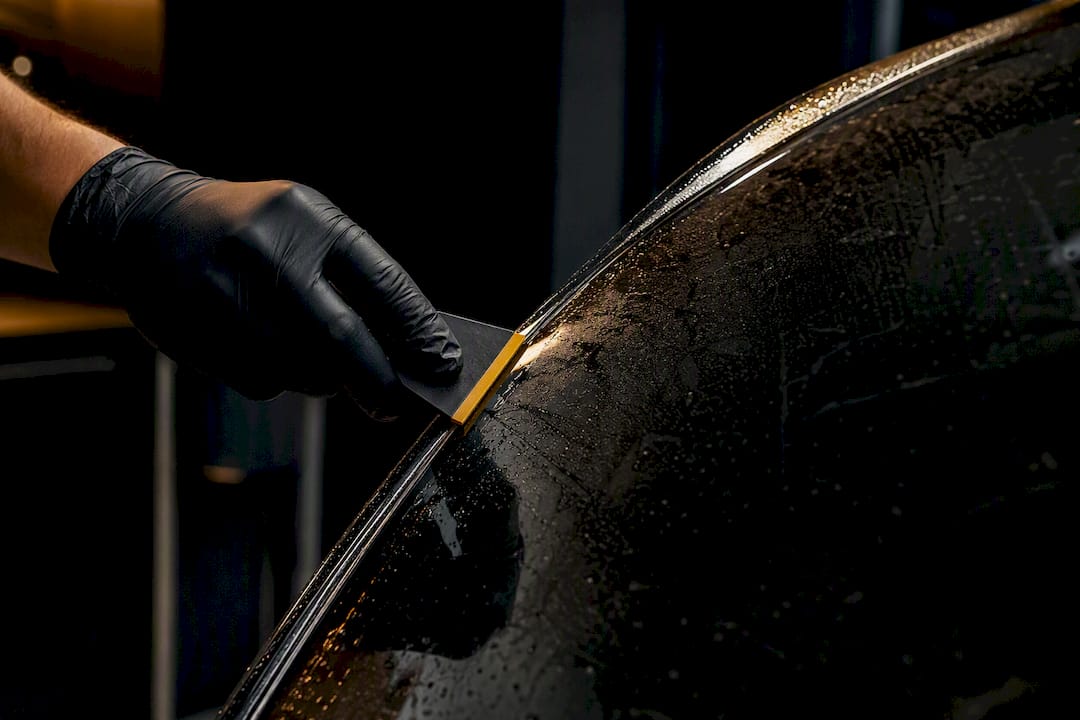
Film performance on paper only matters if the installer applies it correctly. Poor fitment around edges, trapped air bubbles, and the wrong adhesive for your window’s curvature will undercut even the best ceramic film’s IR rejection numbers and shorten its real-world lifespan well below its rated warranty period.
Get warranty terms in writing before the work starts, not after. A legitimate warranty document should specify what’s covered (bubbling, peeling, adhesive discoloration, fading), the coverage period, and whether it’s the film manufacturer or the installing shop that honors claims. If a shop can’t produce this in writing, that’s worth walking away from.
Basic care that protects your investment:
- Avoid rolling windows down for at least 3 to 5 days after install to let the adhesive cure fully
- Skip ammonia-based glass cleaners permanently; they degrade tint film over time
- Use a soft microfiber cloth and a tint-safe cleaner for regular maintenance
- Watch for edge lifting or bubbling near the top corners, which often signals early adhesive failure
Retinting versus repairing depends on scope. Small bubbles near one edge might be fixable under warranty. Widespread peeling, color shift across the whole window, or film that’s visibly separating from the glass usually means it’s time for a full retint rather than a patch job.
Artec Automotive’s Perspective on Choosing the Right Film
Since 2001, Artec Automotive has worked on exotic, classic, and European vehicles where the cost of getting a protective service wrong isn’t just money. It’s original paint, factory glass, and resale value on cars that don’t get a second chance at a clean history. That perspective shapes how we think about ceramic tint or carbon for the vehicles that come through our shop.
For most exotic and collector cars, ceramic tint is the film we recommend more often. These vehicles frequently sit outdoors at shows, on display, or simply because garage space is tight even for owners who have it. The combination of higher IR rejection and superior fade resistance protects both the interior materials and the car’s long-term value in a way that pays for the price difference over the ownership period.
Carbon still earns its place for daily-driven European sedans and coupes that spend most of their time garaged, where the owner’s priority is a clean matte look and solid performance without ceramic’s premium. We don’t push one film as universally correct. We match the recommendation to how the car is actually parked, driven, and valued.
Every vehicle that comes through our doors gets a tailored conversation about film choice, not a default upsell. If you’re weighing ceramic against carbon for a European, exotic, or collector car, booking an inspection gets you a specific recommendation based on your car’s paint condition, glass curvature, and how you actually use it.
— Armen
Get Professional Window Tinting From Artec Automotive
If you own a Ferrari, Porsche, Tesla, BMW, or any European or collector car, the tint decision carries more weight than it does on a mass-market daily driver. It is important to choose a vendor experienced with exotic, classic, and European vehicles who can handle the film choice, installation, and warranty conversation appropriately.
Specialized experience in this category involves fitting tint on curved exotic glass, factory-matte trim packages, and interiors where the wrong adhesive or a rushed install isn’t an acceptable risk. Such specialized care and positive reviews are valued by owners of vehicles that don’t get a second chance if something goes wrong.
Ready to get a film recommendation specific to your car and how you park it? Book a tinting consultation with Artec Automotive and get a quote built around your vehicle, not a generic price sheet.
Sources
- Understanding the Difference Between Carbon and Ceramic Tint in 2026: Which is Right for You? | TintFinder Blog
- Ceramic Tint vs. Carbon Tint: What’s the Actual Difference? — TintGrade
- Ceramic Vs. Carbon Window Tint: Which Is Better For Keeping Your Car Cool? — Jalopnik
- Ceramic vs Carbon Window Tint: Complete Buyers Guide — Gilroy Blackout