
A brake upgrade should not begin with the size of the caliper or the appeal of a carbon rotor behind a set of forged wheels. It should begin with how the vehicle is actually driven. In the carbon ceramic versus steel brakes discussion, the right answer depends less on status and more on heat cycles, driving environment, vehicle weight, and the level of feedback you expect through the pedal.
For a Ferrari, Porsche, BMW M car, Mercedes-AMG, Audi RS model, or a highly modified European build, braking is a complete system. Rotor material matters, but so do pads, fluid, cooling, tire grip, suspension setup, and the driver’s intended use. Choosing intelligently protects both performance and long-term ownership value.
Carbon Ceramic Versus Steel Brakes: The Core Difference
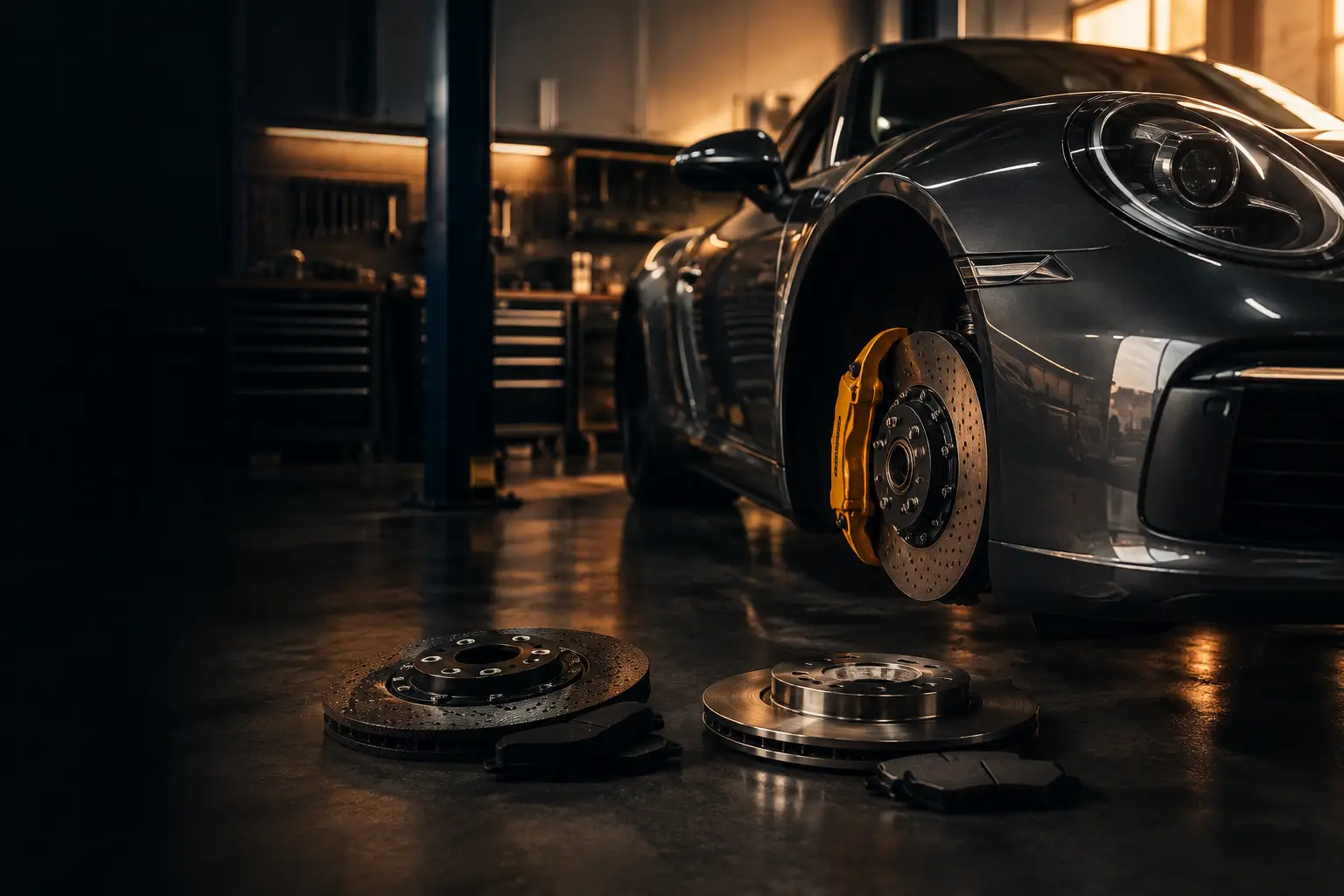
Traditional performance brake systems use cast-iron or steel rotors. They are exceptionally capable, predictable, and well understood. Most factory high-performance cars rely on iron rotors because they generate strong, repeatable stopping power across street and track conditions at a comparatively reasonable replacement cost.
Carbon ceramic brakes use rotors made from carbon fiber reinforced silicon carbide. They are engineered to tolerate extreme temperatures while weighing substantially less than comparable iron rotors. On many exotic and high-performance vehicles, they are offered as an expensive factory option because they reduce unsprung and rotating mass, resist corrosion, and provide remarkable endurance in the right conditions.
Neither material is automatically superior in every situation. Carbon ceramic is a specialized solution. Steel remains the benchmark for broad performance usability.
Weight Changes More Than Acceleration
One of carbon ceramic’s most meaningful advantages is weight reduction. Depending on the application, a carbon ceramic rotor can save several pounds at each corner. That reduction occurs at the wheel, where mass has an outsized effect on how a vehicle responds.
Less unsprung weight allows the suspension to react more effectively to pavement changes. Less rotating mass can improve steering response, turn-in precision, and the sense that the car changes direction with less effort. These differences are most noticeable in a vehicle engineered around the system, particularly a lighter sports car with sophisticated suspension tuning.
For a street-driven luxury performance sedan, the difference may be subtle compared with the effect of tires, alignment, and suspension calibration. For a track-focused Porsche GT model or an exotic car used on demanding mountain roads, the sharper response can be meaningful.
Heat Capacity and Fade Resistance
Hard braking converts speed into heat. Once a brake system exceeds its effective temperature range, pedal feel can change, pads can fade, fluid can boil, and stopping consistency can suffer. This is where carbon ceramic brakes earn their reputation.
Carbon ceramic rotors remain stable at temperatures that would severely stress a conventional iron system. They are highly resistant to heat-related distortion and can deliver exceptional consistency during repeated high-speed braking. On a properly matched factory system, this gives the driver confidence deep into a demanding session.
That does not mean steel brakes are unsuitable for track use. A high-quality iron rotor, track-oriented pad compound, proper cooling, and fresh high-temperature brake fluid can perform at an extremely high level. In fact, many serious track drivers choose iron rotors because they offer predictable friction characteristics, broad pad compatibility, and lower consumable cost when frequent rotor and pad changes are expected.
The distinction is not simply carbon ceramic for track and steel for street. It is about the severity and frequency of heat cycles, the vehicle’s original engineering, and the cost of maintaining each system at its limit.
Pedal Feel and Cold Performance
Brake feel is personal, but it is never trivial. A driver who values confident modulation on Peninsula roads or in Bay Area stop-and-go traffic may prefer the familiar response of a well-maintained steel brake system. Iron rotors tend to provide strong initial bite and a linear pedal feel across a wide range of temperatures.
Modern carbon ceramic systems are far better in cold and wet conditions than early designs, especially when paired with factory-calibrated pads and brake control software. Still, some systems can feel less immediate when cold, may produce more noise, or can seem less communicative during ordinary city driving. A high-performance brake system is not necessarily intended to feel soft or silent.
Pad selection changes this equation considerably. The wrong pad can make either rotor type noisy, dusty, grabby, or disappointing. On premium vehicles, the goal should be a matched system that preserves the intended braking balance and electronic stability-control behavior, not an isolated parts swap.
Durability, Corrosion, and Daily Ownership
Carbon ceramic rotors have an advantage in corrosion resistance. They do not develop the orange surface rust that can appear on iron rotors after rain, washing, or a period of storage. For collectors and owners who prioritize presentation, this is an appealing benefit, especially on an open-wheel design where brake hardware is highly visible.
They can also offer a long service life in normal road use. A carefully driven vehicle with carbon ceramic brakes may go many miles before its rotors require replacement. But longevity should not be confused with immunity. Carbon ceramic rotors can be damaged by impact, improper handling, severe overheating, or incompatible components. Damage may not always be obvious from a casual visual inspection.
Steel rotors wear more conventionally. They may corrode, develop a wear lip, and eventually need replacement, but service procedures are familiar and costs are manageable. For vehicles driven frequently in varied weather, steel brakes can be the more practical ownership choice even when carbon ceramic is technically more exotic.
The Cost Question Is Bigger Than the Initial Option Price
Carbon ceramic systems are expensive to replace. Rotor costs can reach several thousand dollars per corner on some luxury and exotic applications, and the correct pads, sensors, and professional inspection procedures add to the total. An improperly performed service can create a far more expensive problem than the original maintenance need.
Steel rotors and pads are generally less costly and offer a wider selection of OEM, street-performance, and track-focused replacement options. That matters to owners who attend regular track days, where pads and rotors are consumables rather than permanent components.
There is also resale to consider. If a vehicle was ordered with factory carbon ceramic brakes, retaining and correctly maintaining that system can support the vehicle’s originality and desirability. Replacing carbon ceramic components with steel parts simply to reduce maintenance costs may not be appropriate for every vehicle, particularly low-production, collector-grade, or highly optioned examples.
When Steel Brakes Are the Better Performance Choice
A quality steel brake setup is often the best answer for a car that sees frequent track days. It can be serviced economically, tuned through pad compounds, and restored quickly after heavy use. For many drivers, a properly configured iron system provides more useful braking confidence per dollar than an exotic rotor material.
Steel is also a strong choice for high-horsepower modified vehicles that require an upgrade beyond the factory system. Larger iron rotors, multi-piston calipers, proper cooling ducts, and vehicle-specific pad selection can create a package built for the car’s actual weight, tire, and power level. Bigger is not always better, but a well-engineered system is.
When Carbon Ceramic Makes Sense
Carbon ceramic brakes make sense when the vehicle was designed around them and the owner values their complete package of reduced mass, extreme heat tolerance, corrosion resistance, appearance, and factory-correct specification. They are particularly compelling on exotic and premium performance cars that see spirited driving, selective track use, and careful ownership.
They can also be the right choice for owners who want to preserve the vehicle exactly as engineered. On the right car, the visual and technical presence of carbon ceramic brakes is part of the experience, not merely an expensive option code.
Before making a change, inspect the entire braking system. Rotor measurements, pad condition, brake fluid age, caliper operation, cooling, tire condition, and electronic calibration all deserve attention. At Artec Automotive, this vehicle-specific approach is central to performance work: the best result comes from respecting how the car was engineered, then tailoring the solution to how it will be used.
The most satisfying brake system is the one that inspires confidence every time you press the pedal - whether that means a factory carbon ceramic package preserved to exacting standards or a steel setup prepared for lap after lap of hard use.