

From $800 to $5,000: Air Suspension vs Coilovers: Shop Checklist
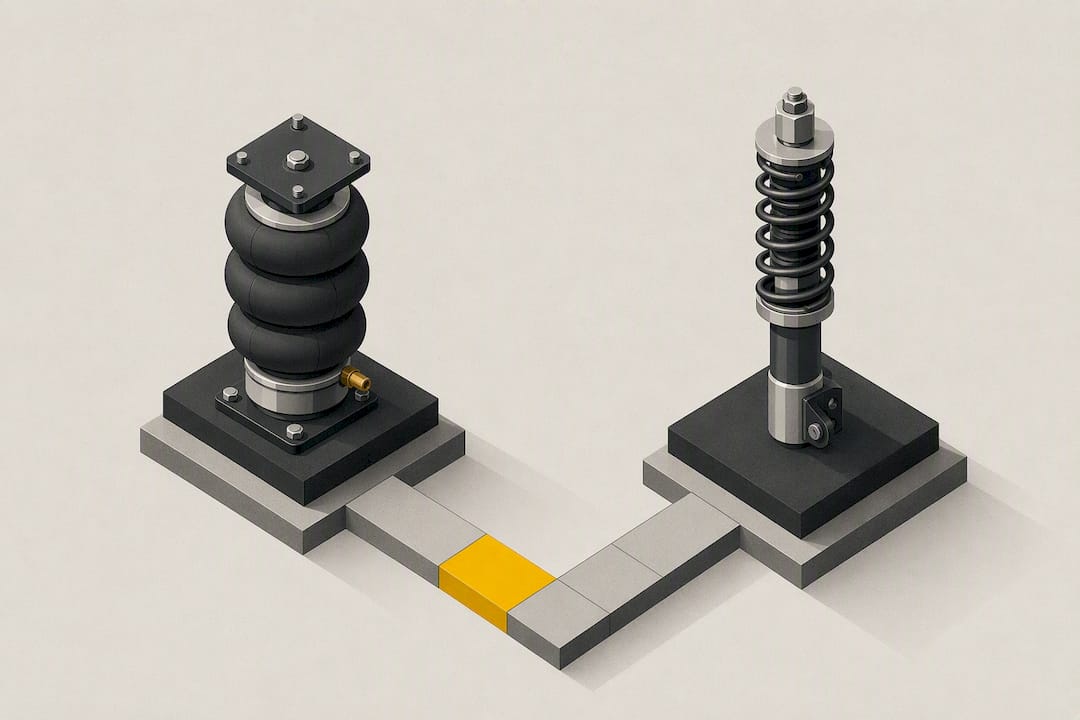
Coilovers win for predictable, track-focused performance. Air suspension wins when you need on-the-fly height control, a smoother daily ride, or load leveling for a show car or heavier build. Coilovers give you consistent, repeatable handling with fewer complex parts to fail. Air suspension trades some of that predictability for comfort and adjustability. The right call depends on how you actually drive the car, which the tradeoffs below will help you sort out.
TL;DR:
- Air suspension is ideal for vehicles needing on-the-fly height adjustment, load leveling, or smooth daily rides, especially on SUVs and trucks.
- Coilovers offer predictable handling, low long-term maintenance, and are favored for track use, autocross, and performance-focused builds.
- Air systems have higher initial costs, more complex installation, and more frequent repairs due to leak-prone parts, while coilovers are generally bolt-in and more durable.
- Proper tuning, quality parts, and professional installation are critical for either system to ensure longevity and avoid premature failure.
- The choice depends heavily on how the vehicle is driven most often, with European and exotic cars often benefiting from tailored expert advice.
Table of Contents
- What Is Air Suspension and How Does It Work?
- What Are Coilovers and How Do They Work?
- Air Suspension vs. Coilovers: Ride, Handling, Cost, and Durability
- How to Choose the Right Suspension for Your Build
- What Maintenance and Repair Costs Should You Expect?
- Artec Automotive’s Take on Matching Suspension to the Right Car
- Suspension Consultation and Installation at Artec Automotive
- Sources
- FAQ
What Is Air Suspension and How Does It Work?
Air suspension replaces conventional coil springs with air filled bellows, commonly called air springs or air bags, that hold the car up using compressed air instead of steel tension. A compressor fills a storage tank, valves route air to each corner, and sensors feed a controller that adjusts pressure to raise, lower, or level the vehicle in real time. The core components work together as a system, not as a single adjustable part, which is why air setups tend to have more failure points than a coilover.
Air pressure inside each bellow acts as the equivalent of spring rate. More pressure firms up the ride and raises the car; less pressure softens it and drops it. That single mechanism is what lets a stanced build sit inches off the ground at a car meet, then air up to clear a speed bump on the drive home.
- OEM systems come factory installed on many luxury SUVs and sedans for ride comfort and load leveling.
- Aftermarket “bagging” kits let owners chase extreme static drops while still driving the car normally, a look and function combination the stance and show community has built an entire culture around.
- Main benefits: ride comfort, adjustable height, load leveling for towing or hauling.
- Main downsides: more components to fail, air leaks, compressor wear, and generally higher repair bills.
What Are Coilovers and How Do They Work?
A coilover combines the shock absorber and coil spring into one bolt-in assembly, which is why the name sticks: the coil sits over the shock body. Threaded collars on the shock body let you set ride height by moving the spring perch up or down, independent of spring preload in most quality designs. Damping adjustment, where available, changes how quickly the shock compresses and rebounds, letting you dial in a firmer track setup or a more livable street tune.
Monotube designs use a single oil-filled tube and typically dissipate heat better under hard track use, while twin-tube designs are usually cheaper and ride a bit softer for street duty. Spring rate, damping, and preload get chosen together based on the car’s weight, corner-weight balance, and intended use, not picked in isolation.
- Ride height and damping adjust mechanically, with settings that hold once you dial them in.
- Monotube shocks favor sustained performance driving; twin-tube favors comfort and cost.
- Advantages: predictable behavior lap after lap, fewer electronic parts, and simpler long-term maintenance than an air system.
Air Suspension vs. Coilovers: Ride, Handling, Cost, and Durability
Here is how the two systems stack up across the factors that actually change your ownership experience.
- Ride quality. Air suspension typically smooths out rough pavement and small bumps better at low to moderate pressures, which is why it shows up on luxury SUVs built for comfort. Coilovers deliver a more controlled, connected ride, especially at firmer damping settings, but that control comes with more feedback from the road.
- Adjustability and ride height. Air systems adjust height in seconds from a controller or phone app, covering an enormous range from slammed to lifted. Coilovers adjust height mechanically through threaded collars, a “set it and leave it” approach that takes a wrench, not a button.
- Handling and performance. Coilovers keep unsprung mass lower and behavior more consistent, which is why they’re the standard choice for autocross and track builds. Air systems can handle well when tuned properly, but the added compressor, tank, and lines usually add weight exactly where you don’t want it for lap times.
- Durability and failure modes. Air suspension’s common failure points are leaking bags, worn compressors, and failed valves or sensors, any of which can leave a car sagging or unable to hold pressure. Coilovers fail more predictably through shock seal wear or spring fatigue over tens of thousands of miles, problems that degrade gradually rather than all at once.
- Cost. Coilover kits commonly run $800 to $2,000 for most enthusiast applications. Air suspension kits typically start in the low thousands and can reach $2,000 to $5,000 or more once you add a compressor, tank, and management system, with install labor running higher too.
- Installation complexity. Coilovers are a bolt-in job for most cars, though alignment afterward is not optional. Air systems involve routing air lines, mounting a compressor and tank, and wiring a controller, which is why a specialty shop with air-ride experience is worth the labor cost over a driveway install.
Where air pulls ahead: SUVs and trucks that need load leveling for towing or hauling, and show cars that need extreme static drop without sacrificing daily drivability.
Where coilovers pull ahead: any build where lap times, autocross results, or predictable cornering behavior matter more than ride height flexibility.
How to Choose the Right Suspension for Your Build
Match the system to what you actually do with the car most often, not what looks best in photos.
- Track or autocross: coilovers, tuned with correct spring rates and damping for your car’s weight and corner balance.
- Daily driving with comfort priority: air suspension, or a quality coilover set softer, depending on how much adjustability you want.
- Show or stance builds: aftermarket air suspension for the static drop and drivability combination.
- Towing or hauling: air suspension for load leveling, especially on SUVs already built for it.
Before you commit, ask any shop you’re considering a few pointed questions: What’s the warranty on air springs, compressors, and shocks? Are replacement parts stocked locally or special-order only? What spring rates and damping settings do they recommend for your specific car and use case? Will they perform an alignment after height changes, since skipping it causes uneven tire wear and sloppy handling?
Treat a few answers as red flags: no local parts availability, no warranty on the compressor or bags, or a vague promise that either system is “maintenance-free for life.” Nothing with moving parts and pressurized components stays maintenance-free forever.
Pro Tip: Bring your car’s actual curb weight and intended use to the estimate, not just a photo of the look you want. Spring rate and damping recommendations change significantly between a 3,200 pound sports car and a 5,500 pound SUV, and guessing wrong means redoing the work.
What Maintenance and Repair Costs Should You Expect?
Air systems need periodic attention to bags, compressors, and valves, the parts most likely to leak or wear out over years of cycling pressure up and down. Compressor replacement and bag replacement are the most common big-ticket repairs, and costs climb quickly once a system starts failing on multiple corners at once.
Coilovers ask less of you day to day, but shocks still need seal service or a full rebuild over time, with shock absorber replacement commonly running $195 to $630 per unit depending on the vehicle. Preventive habits matter for both: check air lines and fittings for leaks, keep coilover threads clean and lubricated, and never skip a post-installation alignment.
- Inspect air lines and compressor mounts during regular service intervals.
- Rebuild or replace shocks when damping feels inconsistent corner to corner.
- Always re-align after any ride height change, on either system.
Installation quality drives longevity more than brand name on either system. A rushed air-line routing job or a coilover installed without proper preload setup will fail early no matter how good the parts are.
Artec Automotive’s Take on Matching Suspension to the Right Car
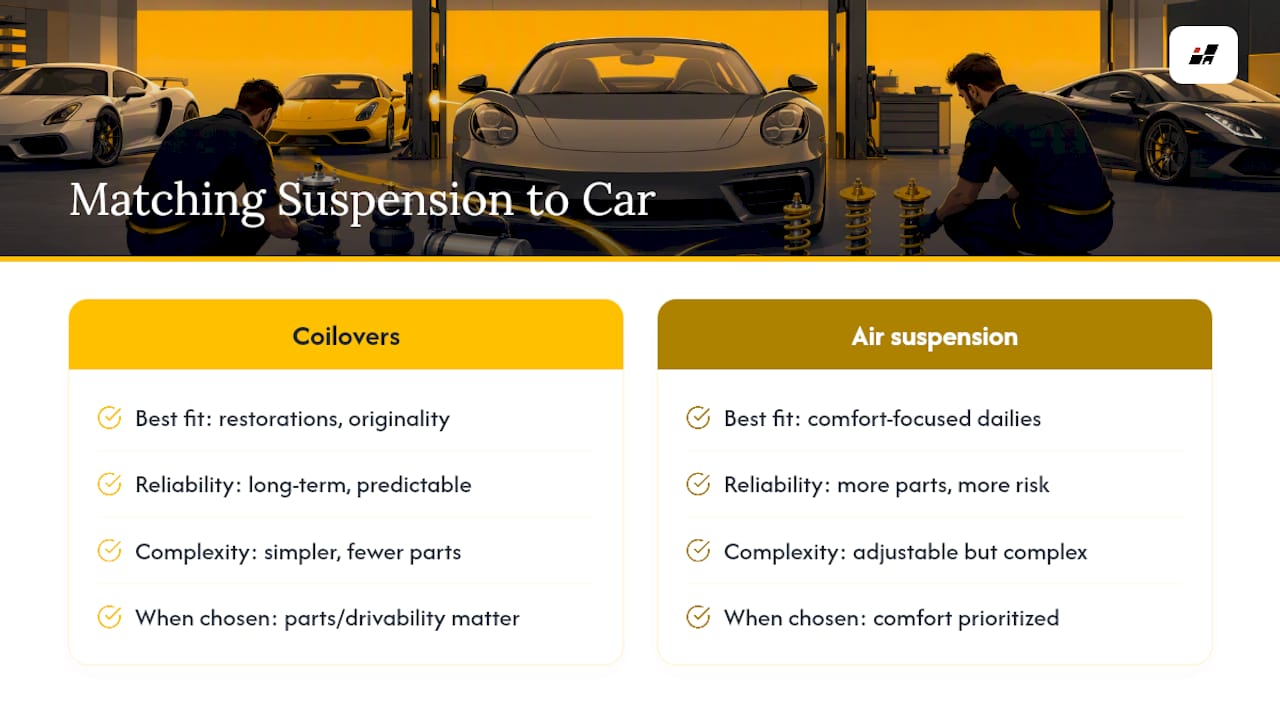
Most exotic and European builds we evaluate don’t need the most adjustable system. They need the right one. A restoration client chasing originality and long-term reliability almost always does better on a well-set coilover than a complex air system with more parts that can fail years down the road. A daily-driven European sedan or SUV with real comfort demands is a different conversation entirely.
We look at curb weight, how the car is actually driven, and how much ownership maintenance the driver genuinely wants to handle before recommending either direction. Predictability and simplicity win more often than flash, especially on cars where parts availability and long-term drivability matter as much as how low it sits at a show.
— Artec
Suspension Consultation and Installation at Artec Automotive
If you’re weighing air suspension against coilovers on a Porsche, Ferrari, BMW, Mercedes, or another European or exotic build, the decision gets more complicated than a generic aftermarket install, and that’s exactly where a specialty shop earns its keep. Some shops provide suspension consultation, installation, tuning, and ongoing maintenance for exotic, classic, and European vehicles, matching the system to your car’s weight, use case, and how much long-term upkeep you’re comfortable with.

Bring your car’s use case (track days, daily commuting, towing, or show duty) along with any modifications already done, and expect us to ask about your tolerance for maintenance before recommending a direction. We’ll walk through spring rate and damping options for coilovers or component quality and warranty coverage for air systems, so you’re not guessing at what fits your specific vehicle. Ready to talk through your build? Get in touch with Artec Automotive to schedule a consultation and estimate.
Sources
- Air suspension pros and cons — MotorTrend
- Coilover suspension deep dive — SLRspeed
- Air suspension vs coilovers vs springs — AccuAir (shop talk)
FAQ
Is Coilover Suspension Better Than Air Suspension?
For performance driving, yes: coilovers give more predictable, repeatable handling with fewer parts that can fail. For adjustability, comfort, and load leveling, air suspension is the better fit.
What Are the Disadvantages of Air Suspension?
Air suspension involves more components, including a compressor, tank, valves, and sensors, any of which can leak or fail, and repairs typically cost more than coilover shock service.
What Suspension Gives the Smoothest Ride?
Air suspension generally delivers the smoothest ride on rough pavement because air pressure absorbs small bumps more readily than a fixed coil spring, though a softly tuned coilover can come close.
Is Air Suspension Good for Daily Driving?
Air suspension works well for daily driving when comfort and ride height flexibility matter, particularly on heavier vehicles or SUVs that benefit from load leveling. Just budget for the higher repair costs if a bag, valve, or compressor eventually fails.