
A new windshield should restore clarity, structural integrity, and confidence behind the wheel. On many late-model luxury and performance vehicles, it must also restore the precise reference point for the forward-facing camera. That is why ADAS calibration after windshield replacement is not an optional finishing step. It is the process that verifies the vehicle’s driver-assistance systems can interpret the road as engineered.
For Bay Area owners of European, exotic, and premium vehicles, this detail matters. A windshield replacement may appear straightforward from the outside, but the glass, camera mount, vehicle geometry, and manufacturer procedures must work together with exceptional accuracy. When they do not, a system designed to support the driver can make decisions based on an incorrect view of the road.
Why windshield replacement can affect ADAS
Advanced Driver Assistance Systems, commonly called ADAS, use cameras, radar, sensors, and software to support features such as forward collision warning, automatic emergency braking, lane departure warning, lane centering, traffic sign recognition, and adaptive cruise control. The exact suite varies by manufacturer and model, but many of these functions rely on a camera mounted at or near the top of the windshield.
That camera does not simply need a clear view through the glass. It needs to know its exact position and angle relative to the vehicle. Removing and reinstalling the windshield, replacing a camera bracket, fitting new glass, or making changes to the front-end geometry can shift that reference point by a small amount. A difference too subtle to see can be meaningful to a camera that must distinguish lane markings, vehicles, pedestrians, and distance at speed.
The replacement glass itself also matters. Premium vehicles often specify windshield glass with a particular optical quality, tint band, acoustic layer, heating element, heads-up display compatibility, sensor window, or camera mounting configuration. A windshield that fits physically but does not meet the vehicle’s specification can compromise image clarity or prevent correct sensor operation. Quality materials and vehicle-specific installation are part of the calibration conversation, not separate from it.
What ADAS calibration after windshield replacement does
Calibration establishes the camera’s relationship to the vehicle and confirms its view is aligned with the manufacturer’s parameters. Depending on the vehicle, this may be a static calibration, a dynamic calibration, or both.
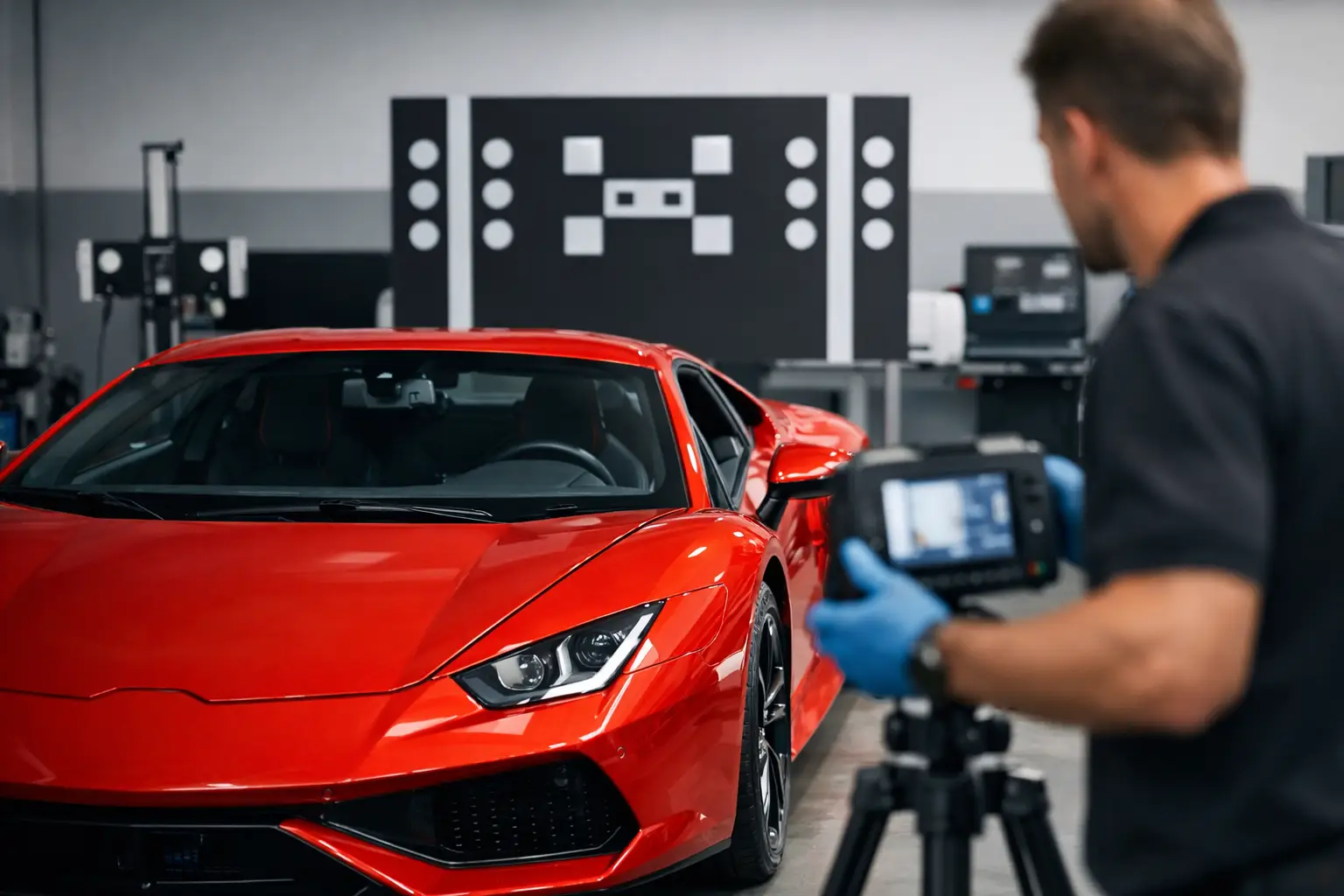
A static calibration is performed in a controlled workshop environment. The vehicle is positioned on a level surface, and specialized targets are placed at exact distances and heights. Diagnostic equipment communicates with the vehicle while the camera recognizes the targets and stores the correct orientation. This process demands measured setup, appropriate equipment, and a space that meets the procedure’s requirements.
A dynamic calibration is completed during a road drive under defined conditions. The vehicle may need to travel at a specified speed on clearly marked roads while the system observes lanes, traffic, and roadside features. It sounds simple, but conditions matter. Heavy rain, faded lane markings, dense traffic, construction zones, or an interrupted drive can prevent the vehicle from completing the procedure.
Some vehicles require one method, while others require both. The correct answer is always vehicle-specific. A shop should follow the applicable manufacturer procedure rather than assuming every windshield replacement calls for the same sequence.
The risks of skipping calibration
A warning light may be the most obvious sign of an incomplete repair, but it is not the only concern. Certain systems may appear available without operating at their intended level of precision. Lane guidance can react too early or too late. Forward collision alerts may be inconsistent. Automatic braking, traffic sign recognition, or adaptive cruise functions may be limited or disabled.
There is also a more practical ownership concern: uncertainty. When a premium vehicle has sophisticated safety technology, owners should not have to wonder whether its systems are functioning as designed after glass work. Proper documentation and post-repair verification provide a clearer record for service history, future diagnostics, and resale conversations.
Calibration is not a promise that a driver-assistance feature will prevent every incident. ADAS remains a support system, and the driver remains responsible for vehicle operation. Its value lies in helping those features operate within the performance envelope the manufacturer intended.
Precision begins before the glass comes out
The best calibration outcome starts with a disciplined windshield replacement. Before installation, a qualified technician should inspect the camera area, mounting bracket, rain or light sensors, trim, seals, and any related fault codes. If the camera bracket is damaged, loose, or incorrectly bonded to the glass, calibration alone cannot correct the issue.
The vehicle should also be evaluated for conditions that affect sensor alignment. A lowered suspension, recent collision repair, damaged bumper components, uneven tire pressures, worn suspension parts, or an out-of-spec wheel alignment can influence the results on certain vehicles. Calibration is not a substitute for correcting a mechanical or structural problem.
This is especially relevant for enthusiast vehicles that have been modified for performance or aesthetics. A well-executed build can coexist with factory driver-assistance technology, but the technician must understand the vehicle’s current configuration and the manufacturer’s calibration requirements. Tailored service protects both the design intent of the build and the systems that support daily drivability.
What a proper appointment should include
A complete service experience should feel considered rather than rushed. The glass should match the vehicle’s required features, the installation should protect surrounding paintwork and interior trim, and the technician should account for the camera and sensor assemblies before disassembly.
After the windshield is installed and adhesive curing requirements are met, the vehicle is scanned for relevant diagnostic faults. The required calibration procedure is then completed with professional diagnostic equipment and accurately positioned targets or a qualifying road drive. Finally, the system status is verified, and the customer should receive clear confirmation of the completed work.
The sequence can vary. Some manufacturers specify an initialization step before calibration. Others require the vehicle to be at a particular ride height, have a fuel level within range, or be fitted with tires of the correct size. These details are why a generic approach is not sufficient for a modern Mercedes-Benz, BMW, Porsche, Audi, Tesla, Land Rover, or other technology-intensive vehicle.
Static versus dynamic calibration: which is better?
Neither method is universally better because the vehicle manufacturer determines what the system needs. Static calibration offers controlled conditions and repeatable target positioning, making it especially valuable when a camera’s baseline orientation must be set precisely. Dynamic calibration allows the system to validate itself through real-world road inputs.
In practice, the best method is the required method. A shop that can explain whether your vehicle needs static, dynamic, or combined calibration is demonstrating the level of care the repair deserves. Be cautious of blanket statements that every car can be handled with a quick road drive or that every vehicle follows the same target-based process.
When calibration may be required beyond new glass
Windshield replacement is a common trigger, but it is not the only one. Calibration may also be needed after camera replacement, collision repair, suspension or ride-height changes, wheel alignment work, bumper or grille repair, certain software updates, or a windshield camera fault. The trigger depends on the system architecture and repair instructions for the specific vehicle.
If an ADAS warning appears after a repair, do not assume it will clear on its own. A diagnostic evaluation can determine whether the issue is a calibration requirement, a sensor communication fault, a camera obstruction, incorrect glass specification, or an unrelated vehicle concern. Addressing the cause is more valuable than simply clearing a code.
A higher standard for a critical repair
At Artec Automotive, windshield service is approached with the same respect given to paint protection, performance work, and bespoke vehicle care. The goal is not merely to replace a damaged pane of glass. It is to preserve the vehicle’s visibility, technology, aesthetics, and confidence on the road.
Before scheduling replacement, ask whether your vehicle has a windshield-mounted camera or active driver-assistance features, whether the specified glass will be used, and how calibration completion will be verified. Those three questions help turn a necessary repair into a properly finished one - exactly what a precision vehicle deserves.