
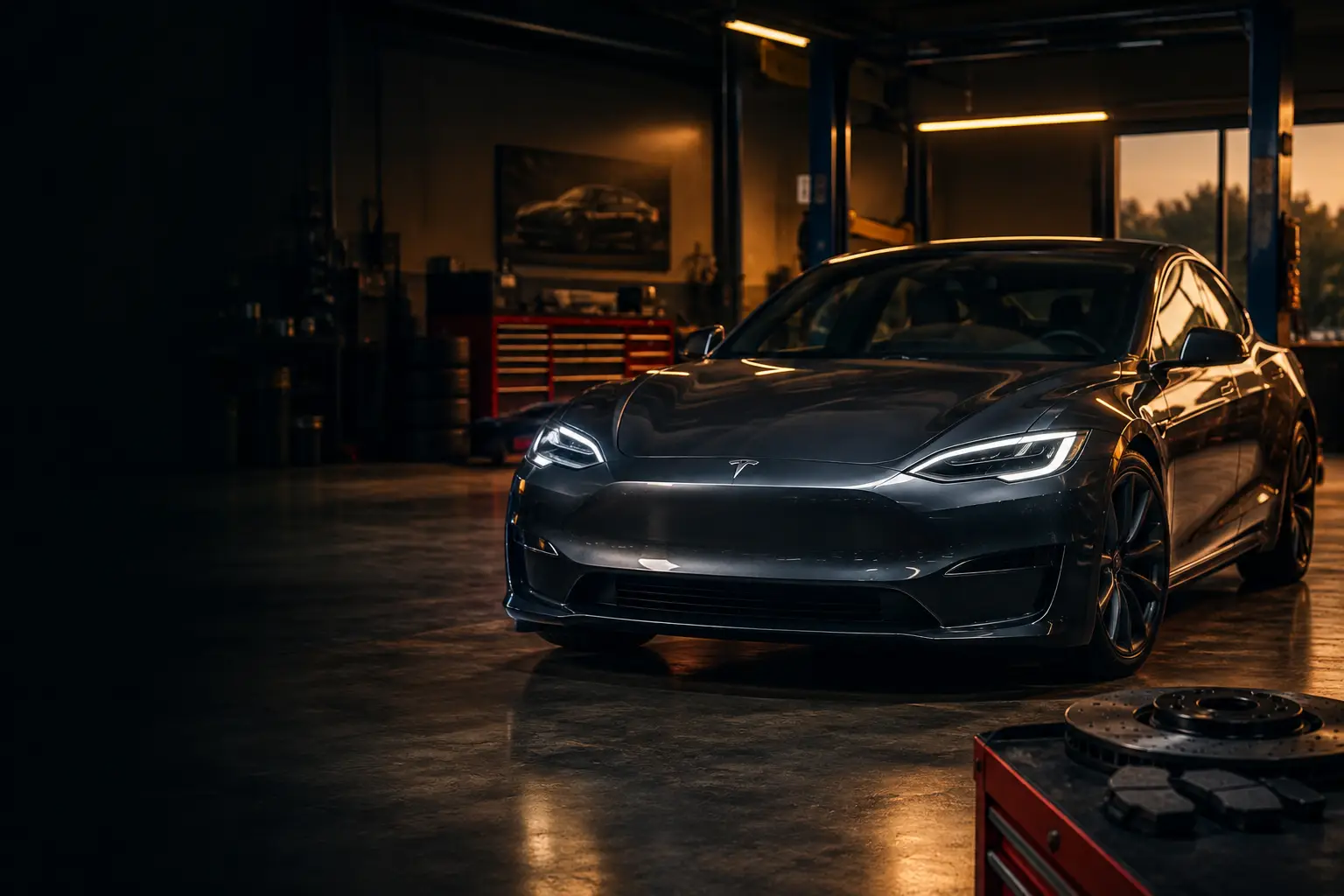
A Tesla can go far longer between brake-pad replacements than a conventional performance car, but that does not mean its braking system can be ignored. In fact, Tesla brake maintenance requires a different mindset: regenerative braking reduces pad wear, while limited friction-brake use can allow corrosion, sticking hardware, and rotor surface issues to develop quietly.
For Bay Area owners, that distinction matters. Stop-and-go traffic, steep Peninsula and San Francisco grades, coastal moisture, and periods of low vehicle use each place different demands on a Tesla's mechanical brakes. The objective is not frequent replacement. It is preserving the full stopping system so it responds cleanly and confidently when regenerative braking is limited, unavailable, or simply not enough.
Why Tesla Brakes Age Differently
Most deceleration in normal Tesla driving comes from the electric motor's regenerative braking. When the driver lifts off the accelerator, the motor captures energy and returns it to the battery while slowing the vehicle. This is one of the defining advantages of EV ownership: less friction, less heat at the pads and rotors, and often dramatically longer pad life.
The trade-off is that the conventional hydraulic brake system may work less often and less aggressively than it would in a gasoline vehicle. Rotors are bare metal. In damp air, after rain, or near the coast, a light layer of surface rust can form quickly. A few firm brake applications will often clear it. But when the friction brakes rarely reach proper operating temperature, corrosion can become more than cosmetic.
Brake pads can also glaze or wear unevenly, caliper slide pins can lose free movement, and a rotor can develop pitting or an uneven contact surface. None of those conditions are guaranteed on every Tesla. They depend on climate, driving habits, storage conditions, mileage, and how often the vehicle is washed and driven. Still, they explain why a Tesla with plenty of pad material can need brake attention.
The Tesla Brake Maintenance Items That Matter
A professional inspection should look beyond pad thickness. The technician should assess rotor condition on both faces, measure remaining pad material, inspect caliper movement and hardware, examine flexible brake hoses, and check for fluid leaks or irregular wear patterns. The parking brake system at the rear also deserves attention, particularly because modern electronic parking-brake components require model-specific service procedures.
Rotor Condition Is More Than Surface Rust
A thin orange film after an overnight rain is normal. Persistent rust rings, roughness, deep pitting, or dark areas that do not clean up after measured friction-brake use are different. These can indicate that the pad is not contacting the rotor evenly or that corrosion has progressed beyond the surface.
The driver may notice a scraping sound, a pulsing pedal, vibration during braking, or reduced smoothness as the vehicle comes to a stop. Those symptoms should not be dismissed as simply part of EV ownership. They warrant inspection before a minor rotor issue becomes a larger brake job.
Calipers Need Freedom of Movement
Tesla brake calipers, like those on any vehicle, rely on properly moving pins, pads, clips, and contact points. If corrosion or old lubricant restricts that movement, one pad may work harder than the other. The result can be uneven wear, brake drag, heat buildup, or a vehicle that does not brake with the consistency expected from a premium electric car.
A proper brake service can include cleaning corrosion from relevant contact surfaces, servicing hardware where appropriate, and applying the correct high-temperature lubricant in the correct locations. This is precise work. Lubricant on a friction surface, damaged boots, or improperly handled electronic parking-brake components can create problems rather than solve them.
Brake Fluid Still Has a Job to Do
Regenerative braking does not eliminate hydraulic brake fluid. The fluid remains essential whenever the friction brakes are applied, including hard stops, emergency braking, and conditions where battery temperature or charge state reduces available regeneration.
Brake fluid absorbs moisture over time. Tesla maintenance guidance varies by model and year, but commonly calls for periodic brake-fluid contamination testing rather than automatic replacement on a fixed annual schedule. The right approach is to follow the maintenance schedule for the specific vehicle and use test results, age, and system condition to determine whether a fluid replacement is warranted.
When Regenerative Braking Cannot Carry the Load
A Tesla's friction brakes are not merely a backup system. They are designed to work with regenerative braking as part of a coordinated braking strategy. Under hard braking, at low speeds, when the battery is cold, when the battery is near full charge, or when traction conditions limit regeneration, the hydraulic brakes become more significant.
That is why a vehicle can feel perfectly normal during gentle daily commuting while still having neglected mechanical brake components. A strong brake pedal and clean, consistent response under heavier braking are the standard to preserve.
Drivers who primarily use one-pedal driving may benefit from occasional deliberate brake use in a safe, controlled setting. The goal is not aggressive driving or improvised brake bedding. It is allowing the friction brakes to perform enough work to keep rotor surfaces active. If there is already noise, vibration, roughness, or visible corrosion, an inspection should come before any attempt to clear it through driving.
Signs Your Tesla Should Be Inspected
Brake concerns are not always obvious, especially when regenerative braking masks early symptoms. Schedule an inspection if you notice persistent squealing, grinding, a steering-wheel or pedal vibration during braking, a pulling sensation, reduced stopping confidence, or a burning odor near a wheel after driving.
Visible rotor pitting, a vehicle that has sat for weeks, repeated driving in wet or coastal conditions, and an upcoming mountain trip are also sensible reasons to have the system evaluated. A pre-trip inspection is particularly valuable before carrying passengers and luggage through long descents, where sustained friction braking may be required.
Mileage alone is an incomplete service trigger. A Tesla driven 30,000 miles in dry conditions with regular freeway use may present differently than one driven 10,000 miles on short trips near the coast. Time, environment, and use pattern matter as much as the odometer.
Choose Service That Understands EV Procedures
Tesla brake work is conventional in principle but vehicle-specific in execution. The vehicle must be lifted at approved points, service modes and electronic parking-brake procedures must be followed where applicable, and technicians should understand the relationship between regenerative and friction braking. A generic pad-and-rotor recommendation without a careful inspection is not the level of care a premium EV deserves.
For owners who want their Tesla maintained as both a performance vehicle and a long-term asset, brake care also fits into a broader preservation plan. Wheel cleaning that removes corrosive brake residue, proper storage conditions, and routine inspections after wet seasons all support the mechanical system. At Artec Automotive, that same vehicle-specific approach informs every aspect of protection, repair, and cosmetic preservation.
A Practical Maintenance Rhythm
Start with Tesla's published maintenance schedule for your exact model year, then adjust for your environment and driving profile. Vehicles exposed to salt-treated roads need more frequent brake cleaning and lubrication than cars in the mild Bay Area climate. Yet Bay Area owners should not assume they are exempt: coastal air, seasonal rain, infrequent driving, and steep local roads create their own set of variables.
During routine tire service or an annual vehicle inspection, ask for a documented review of pad thickness, rotor condition, caliper operation, and brake-fluid status. That creates a useful record over time and helps identify a developing issue before it becomes expensive. If replacement is needed, the decision should be based on measured wear, rotor integrity, and braking performance, not a generic interval.
A well-maintained Tesla should deliver the quiet, controlled stopping feel its engineering promises. Keeping the friction brakes healthy is what ensures that confidence remains when the road, the weather, or a sudden stop asks more of the vehicle than regenerative braking alone can provide.